STAYING TRUE TO ONESELF: LIFE AND WORK IN CHANGING SLOVAKIA
Double-click to edit...
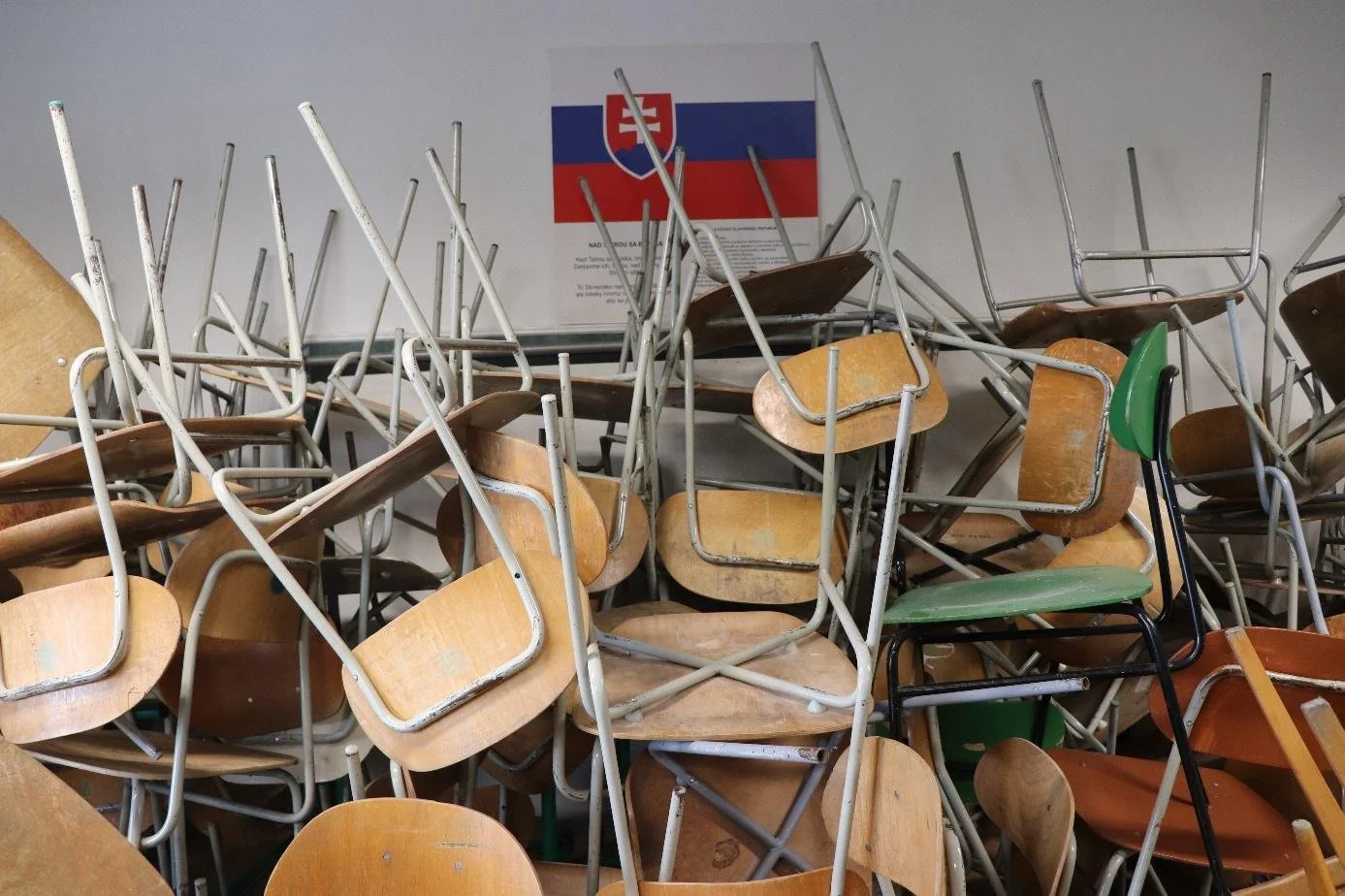
Adam Engler: “Above the Tatras, Education is Shrinking.” 2024, photo series.
-by Adam Engler
We were born into structures that collapsed before we had time to understand them. From communism[1] through wild privatization to the current form of second-wave capitalism, in which we ride on the backs of the countries from the Global South while experiencing our own social fatigue. I perceive the fragmentation of society—communities are falling apart, and although we all intuitively feel that change is necessary, we can’t agree on what kind.
Being an independent artist and an educator is becoming increasingly difficult in Slovakia. We live in a time when society is closing itself off into ideological frameworks in which otherness, critical thinking, and autonomy are no longer welcome. As a visual artist, teacher, activist, and citizen, I realize that if I want to remain in this environment, it will require more and more mental labour and inner discipline to remain true to myself.
During this period, I am searching even more for a space where it is possible to combine art, activism, and humanity. In my doctoral research and my upcoming art project, I focus on connecting Queer organizations and PRIDE initiatives in a European and global context. In collaboration with other artists and communities, we are creating a participatory art project designed to enable an exchange of experiences, mutual support, and a joint search for a language that transcends mere categories of identity. I believe that art can become a place of connection and healing, and not just an aesthetic experience.
However, I will have to pursue this endeavor in a country where artistic freedom is already under ideological pressure. Under the incompetent leadership of often conservative forces, the Ministry of Culture has refused to support[2] dozens of cultural events—especially those that address minorities, gender equality, or critical thinking. Festivals such as Drama Queer, Tehláreň, [fjúžn], and Architecture Days have been left without support, not because of professional inadequacy, but for purely ideological reasons.
The public broadcaster RTVS found itself under threat[3] when political elites attempted to replace its independent news coverage with centralized state broadcasting. The Slovak National Gallery is undergoing personnel purges that devalue its production and undermine confidence in an institution that was recently renovated at a cost of millions of euros.[4] Behind-the-scenes pressure to conform to the state’s agenda, the rejection of contemporary art, and the replacement of professionals with "loyal" actors create smokescreens to cover up infrastructural changes with long-term consequences.
I, too, have been a victim of such censorship. I was part of a fashion project presenting designs made from recycled linen, a material that symbolizes sustainability and a connection to tradition. I myself modeled these designs in the accompanying photo campaign. However, the management of the Center for Folk Art Production (ÚĽUV) refused to exhibit this work, "Change after 100 Years," by renowned author and clothing designer Ina Budovská. They did not like the installation with photographs of a man in women's clothing. This decision is a clear example of how art and free expression are limited under the guise of preserving traditional values and "national identity."
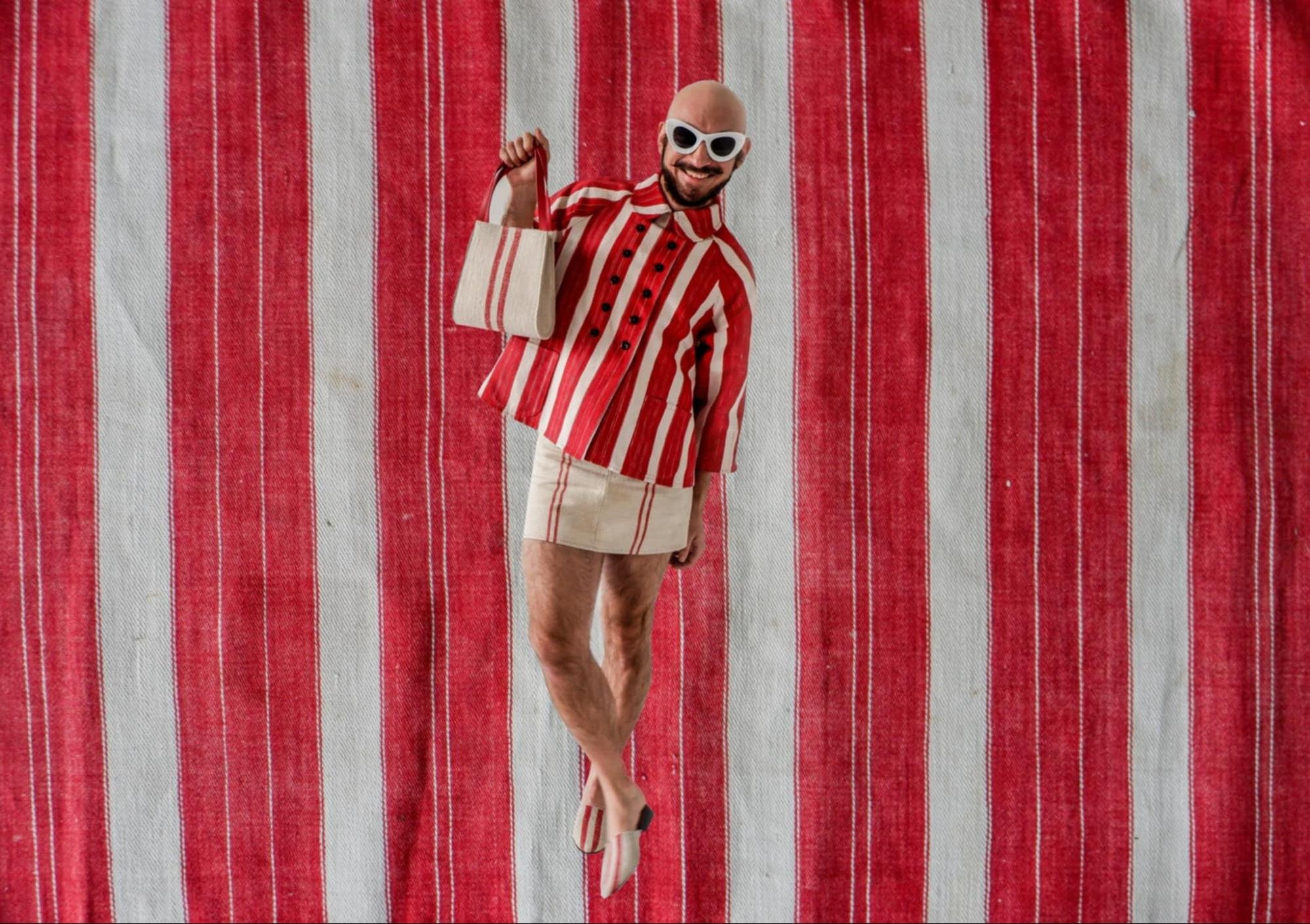
Change after 100 years, linen clothing – in collaboration with Ina Budovská.
This demagoguery spreads polarization in culture, and anyone who points out a problem is the problem. "Activist" has become a pejorative term in Slovakia; every critical work is "propaganda," and freedom has to constantly “defend” itself. That is why it will be important to continue engaging in civic initiatives—to cooperate with platforms such as Open Culture, a platform promoting plurality, openness, and critical thinking in culture, and ŠOK, Students for Open Culture.
At the same time, we are all eagerly awaiting the upcoming elections. Even though many know that the outcome may not bring about fundamental change and may be disappointed, we still place our hope in democratic mechanisms while we still have them. Political tensions and failures in the area of EU fund absorption only exacerbate social frustration and undermine public confidence in institutions.
My ambition is to continue developing a practice that creates space also for silence, reflection, and mutual listening. It is important to open up spaces where the viewer does not have to prove anything, but can simply be. With the support of Amnesty International and other initiatives, such as Pride Banská Bystrica, which we have been organizing for eight years now, we strive to continue building community when our rights and freedoms are subject to constant suppression and criticism. The eighth annual Pride in Banská Bystrica is proof that even in difficult conditions, it is possible to bring the community together and stand up for freedom, dignity, and equality. These events are often the target of harsh criticism and ideological attacks, but that is precisely where their strength lies—they are an expression of courage and determination not to give in to pressure.
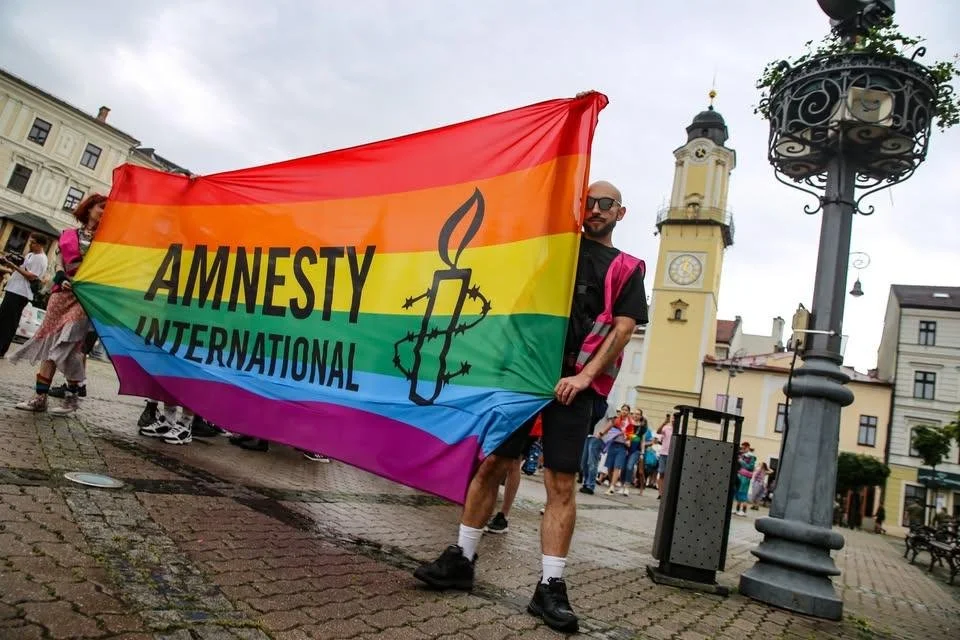
Pride Banská Bystrica – PRIDE BB. Photo by Marcela Záchenská.
Budapest Pride is an inspiring example of how to confront restrictions on freedom effectively and courageously. Our own experience with normalization[5] reminds us that the only way to resist the regime’s pressure and fear-mongering is through unity and mass demonstrations of solidarity. When many people attend the Pride, the regime is in the weaker position; it cannot afford to crack down without provoking an even greater response and triggering an avalanche of support and solidarity.
This experience is also a warning for us that soon, we may face fear and humiliation that could affect our choices. That is why it is important to realize that the more people are not afraid and show their support for freedom, the stronger we will all be together. Our courage, our participation, and our unity are the best defense against attempts to restrict our rights.
The Pride is not only a celebration of identity, but also a powerful tool to build social resilience and a reminder that freedom cannot be taken for granted—we must fight for it every day. This idea strengthens us and gives us hope for the future, that despite pressures and challenges, we can stand firm and unwaveringly for what is right.
Living in the present and not letting it corner us is a challenge, especially in times of social or personal uncertainty. I often feel pressure from the outside world—whether it's political tension, criticism of my work, or the feeling that change isn't coming as quickly as we would like. Nevertheless, the ability to remain true to oneself and one's work is key.
Creation, whatever form it takes, is an expression of our authentic experience and the value we bring to the world. Every frame, every text, every idea has the potential to resonate, even if it may not be immediately apparent to wider society. The work of an artist, educator, or activist creates quiet waves that gradually spread.
Believing in the meaning of our work means knowing that even if the situation does not seem ideal, we are contributing to building something bigger. Living in the present means accepting what is with openness and courage, focusing not only on the result but also on the process itself. Every day we create, learn, or seek connections is a valuable one.
From this perspective, it is not important whether the world changes for the better right away. What is important is that we are part of that change, each in our own unique way. And that is the power that keeps us calm and, at the same time, in motion.
I remain faithful to the idea that, in the gallery or a forest, everyone can have their own unique experience, and that it is this diversity that keeps culture alive. While the world is changing and Slovakia is struggling with itself, I believe that art can remain a space of meaning, connection, and hope amidst despair. Because what we pay attention to grows.
Notes
[1] Referring to the so-called communist regime in Czechoslovakia between the years 1948–1989. More on this topic can be found HERE
[2] Močková, Jana. Denník N. “LGBTI+ projekty nedostali z dotácií u ministerky Šimkovičovej „ani cent“. Je to absurdné, reagujú kvír organizácie” [LGBTI+ organizations didn’t receive a cent from Minister Šimkovičová’s subsidies. Queer organizations react: It’s absurd!]. November 6, 2024. Online HERE
[3] Sopóci, Patrik. SME SK. “Únos verejnoprávnosti v priamom prenose. Všetko, čo potrebujete vedieť o kríze v RTVS” [The hijacking of public service broadcasting live on air. Everything you need to know about the crisis at RTVS]. April 26, 2024. Online HERE
[4] Močková Jana. Denník N. “Odvolaná riaditeľka SNG Kusá: Je mi to ľúto, ale nie sme bezmocní” [Dismissed SNG Director Kusá: I'm sorry, but we are not powerless]. August 7, 2024. Online HERE
[5] Normalization in this context refers to the period following the Warsaw Pact invasion of Czechoslovakia in August 1968 characterized by the restoration of the conditions prevailing before the Prague Spring reform period. See more online HERE
Adam Engler is a Slovak transmedia artist and PhD student at the Academy of Arts in Banská Bystrica, Slovakia. During his studies, he completed internships in art and human rights centers in Berlin, Porto, New York, and Cluj-Napoca. Engler actively exhibits in Slovakia and abroad and works as a photography teacher in Bratislava. He is also co-founder and co-organizer of the annual human rights event PRIDE Banská Bystrica. In his art practice, he works with the medium of photography and media installations. Thematically, his work is devoted to socially engaged art, Queerness and reflection on contemporary social and ecological challenges, especially in the context of (Eastern) Europe.