Meeting the needs.
Interview with museum educator Eglė Nedzinskaitė
by Goda Aksamitauskaitė
(interview took place in 2023)
G: Eglė, it’s quite challenging to list all the groups of people you have worked with as an art educator: teenagers, seniors, children with dyslexia, Roma children, blind and visually impaired individuals, refugee women, homeless individuals, people with autism spectrum, ones with dementia, and others with various physical, psychological and social needs. In the field of education and in the rhetoric of funding competitions, I have noticed a tendency (or necessity) to emphasise ‘communities.’ I wanted to ask you how you define community in your own practice. You primarily work at the National Gallery of Art, a public institution where exhibitions and activities are ever-changing. Given these conditions, is it possible to ensure the sustainability of collaborations with specific groups and communities?
E: Community members may differ a lot in education, age, hobbies and other aspects. However, what unites them is a common problem or issue. With their varied competences, they can help each other, while not necessarily spending all of their time together. Take, for instance, the gardening community (Eglė is referencing the National Gallery of Art’s exhibition ‘Overseeing 6 Ares. Collective Gardens’). Today, if I need strawberries, I can reach out to someone who either has them or knows a lot about growing them. Tomorrow, if I run into a problem with my roof, I can turn to someone who has expertise on roofs. I become the link between the ‘strawberry growers’ and the ‘roofers’, each of whom has their own additional connections. Together, we form a community, a vibrant network of contacts. It is not possible, nor should one attempt to, be conscious of its full entirety.
When I work with a community (or some part of it) within the museum, my connection with its members is based on a theme derived from the content of the exhibition. However, the formats of engagement can vary. For instance, in the blind community, some individuals are keen to participate in workshops, while others prefer tactile tours. Some of them frequent libraries or day centres but not museums.
As an institution, we have the capacity to think and act with a longer-term perspective, with less concern regarding project-based funding and annual reports. This enables us to develop and nurture ideas (very often one initiative leads to another), so it is certainly feasible to establish and cultivate a sustainable relationship with the community. However, the key thing is that there are people within the community who are interested in and in need of such cooperation. I cannot just independently come up with a problem, especially for a more vulnerable group, then craft a solution to it, and present it to them, saying ‘this is what we are going to do about you now.’
G: How do you approach people in a particular community? Through personal acquaintances, professional networks, NGOs, or do you wait for them to approach you?
E: Various methods can be effective. One of them involves engaging directly with the community, informing them about our activities, inviting them to visit our building, but refraining from suggesting or imposing that they should accept a pre-packaged product. The physical characteristics of our space and the status associated with an institution such as the National Gallery of Art can sometimes act as significant barriers to people feeling easy and comfortable. Initially, we might come across as a cold bureaucratic entity rather than as individuals with their own life experiences, feelings etc. While you and I might believe everything is great at the gallery with many opportunities to engage in all kinds of activities, those from outside might find that crossing this psychological threshold, bridging this gap, takes a lot of courage. Getting comfortable with each other is a lengthy process, and it’s not always successful.
We have just finished the ‘Awakening Creativity’ workshop series with Artscape. It was designed for women from diverse countries and cultures, including those who had to leave their lives behind for safety, and those in whose cultural milieu refugees now find themselves. Greta Jalmokaitė and Farah Mohammed, who both have valuable experience in working with refugees, co-facilitated the workshop alongside me. However, only a few participants turned up. When individuals do not feel secure in their daily lives, it isn’t enough for Greta or Farah to simply assure them that everything is fine with me and the NGA. In such cases, even personal connections cannot guarantee a smooth process and the achievement of our goals.
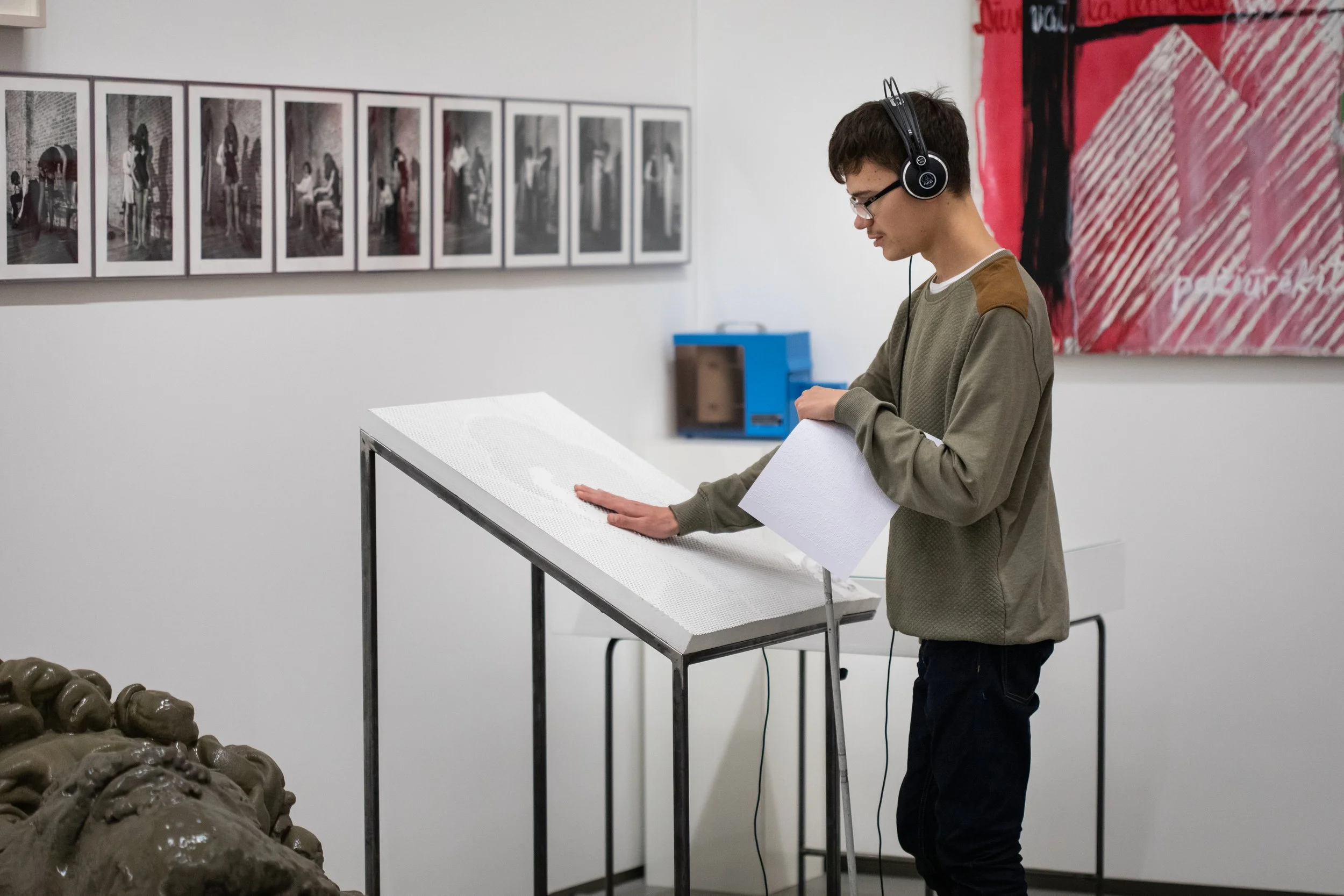
In the case of the blind and visually impaired community, I was aware of a very strong demand for visual art production on their part. Lina Puodžiūnė, culture and art project manager at the Lithuanian Union of the Blind and Visually Impaired, was the driving force behind the whole process and actively contributed in bringing to life the Blind Date exhibitions. If we had come up with the exhibitions on our own, it would have been challenging to get blind individuals to come, as we would not have had their trust. This serves as an example of successful cooperation because, from the outset, the community openly communicated their needs, offered advice, shared their knowledge, and in turn, we shared ours. It is important to bear in mind that the museum itself possesses a deep expertise on art, knows its own content, and has the capacity to tailor it in accordance with the interests of its audience. In the case of the Blind Date exhibition, where one of the aims was to unveil the history of Lithuanian art, if the selections had been made exclusively by the blind community, figures such as Mykolas Šalkauskas or Vytautas Kairiūkštis might not have been included. The museum’s role is to convince people that Kairiūkštis, for example, is an individual of great importance without whom the history of Lithuanian art could not be adequately conveyed. Consequently, blind individuals now have the opportunity to learn about who Kairiūkštis was. This is a mutually beneficial form of education rather than a one-way service. Regrettably, a year ago, the new leadership of the Union deemed culture unnecessary and subsequently abolished the department.
We don’t tend to become close friends with the project participants, that’s not one of our aims. The primary objective is to encourage them to ‘try on’ the spaces, understand what can be expected, become acquainted with me and build trust with me and the other staff members. This way, the seemingly cold bureaucratic apparatus takes on human faces that one can always approach when needed.
G: Working with such diverse groups necessitates distinct competences, methods and, ultimately, personal qualities. One person can hardly cover it all. How do you approach this challenge? Perhaps through training, one can acquire not just the necessary techniques but also empathy?
E: Again, at the NGA, our expertise is in art. On other matters, we are in constant dialogue with group representatives and experts, searching for meaningful ways to coexist and collaborate. One school of thought is that you can’t ‘harm’ a visitor in an art space – art is soothing, beautiful, things are positive, so any experience will ultimately be beneficial. I don’t agree with this notion and I don’t believe it has much to do with education either. It seems to me that choosing the wrong activities or approach can indeed have a negative impact on a person, although I don’t dismiss the possibility that my perspective might be influenced by my own personal fears. But you can always just ask. And people will answer. Or they may remain silent but react in some other way. From that, I determine whether it is feasible to proceed in the chosen direction.
I always have a reason or pretext for the conversation at hand – an exhibition, a work of art etc. It gives me a solid foundation and allows me to go back or change trajectory when necessary, removing the burden of a personal relationship. You can discuss just about anything through a work of art, and more often than not, people still end up talking about themselves. :) I also find myself in an uncomfortable position in that I have to identify the group and their expectations and embark on a journey together. For instance, you can’t simply impart knowledge to five-year-olds because what they require is experiential learning. On the other hand, seniors might not feel satisfied unless they’ve learnt something new that day (a fact, a date etc.), regardless of how much of a show the artists put on. When I work with autistic individuals, I have come to realise that my goal is not to teach them something but rather to create a safe environment. That is, to make it possible for them to come to the gallery in the first place (through managing visual and auditory noise etc.). Then we can talk about their interests and what we have to offer.
G: Do you think that one of the reasons why the NGA hasn’t carried out continuous projects with LGBTQ+ communities could be that it is difficult for us to identify their needs, and we haven’t received direct enquiries from them? A prominent figure in the art world once told me, somewhat humorously but in earnest, that there is no such thing as the gay community, because aside from their sexual orientation, he felt he had nothing in common with other homosexual individuals. It’s only the general public that perceives a diverse range of individuals as them, the community. While many cultural initiatives (queer festivals, themed film programmes, readings etc.) contradict this position, it was interesting to hear this perspective. Could it be that we are also misidentifying or haven’t found the right approach in this regard?
E: Who exactly are ‘they’? When it comes to the blind community, it’s clear to me – they can’t see, so we, as a visual arts institution, must to utilise certain tools to convey the art in formats that are accessible to them. Working with specific needs groups is all about employing the right tools. For autistic individuals, their needs are primarily physical, such as ensuring the institution is accessible and minimising irritating stimuli. Meanwhile, what way of engaging with art could I suggest for the LGBTQ+ community? Especially given that many active artists are themselves members of the community. Currently, I don’t see a specific problem I could help them solve within our museum’s range of services.
In 2021–2022, I worked on the project ‘That Strange Art’, which involved teenagers aged 15–18 selected through an open competition. They organised and brought to life an exhibition at the NGA entirely from scratch. The exhibition was intended to be relevant and meaningful to them and their peer group. Surprisingly, among the 30 or so themes and topics they came up with, not a single one was about sexuality. They did not raise any questions related to these topics in the selection of works, in the programme of events or in the exhibition’s communication. One of the teenagers was homosexual and once introduced his other half to all the participants. However, his primary concern was the fact that his partner lived abroad and they could not meet frequently. One girl felt uneasy because she spoke Lithuanian with an accent. The exhibition mainly focused on youthful confusion, distraction, abstract anxieties about the future, and low museum attendance in their age group, but not issues of sexual identity. Of course, the participants represented only a small sample, but the experience was very valuable for me as an opportunity to test my own preconceptions and to teach myself not to project my assumptions onto others.
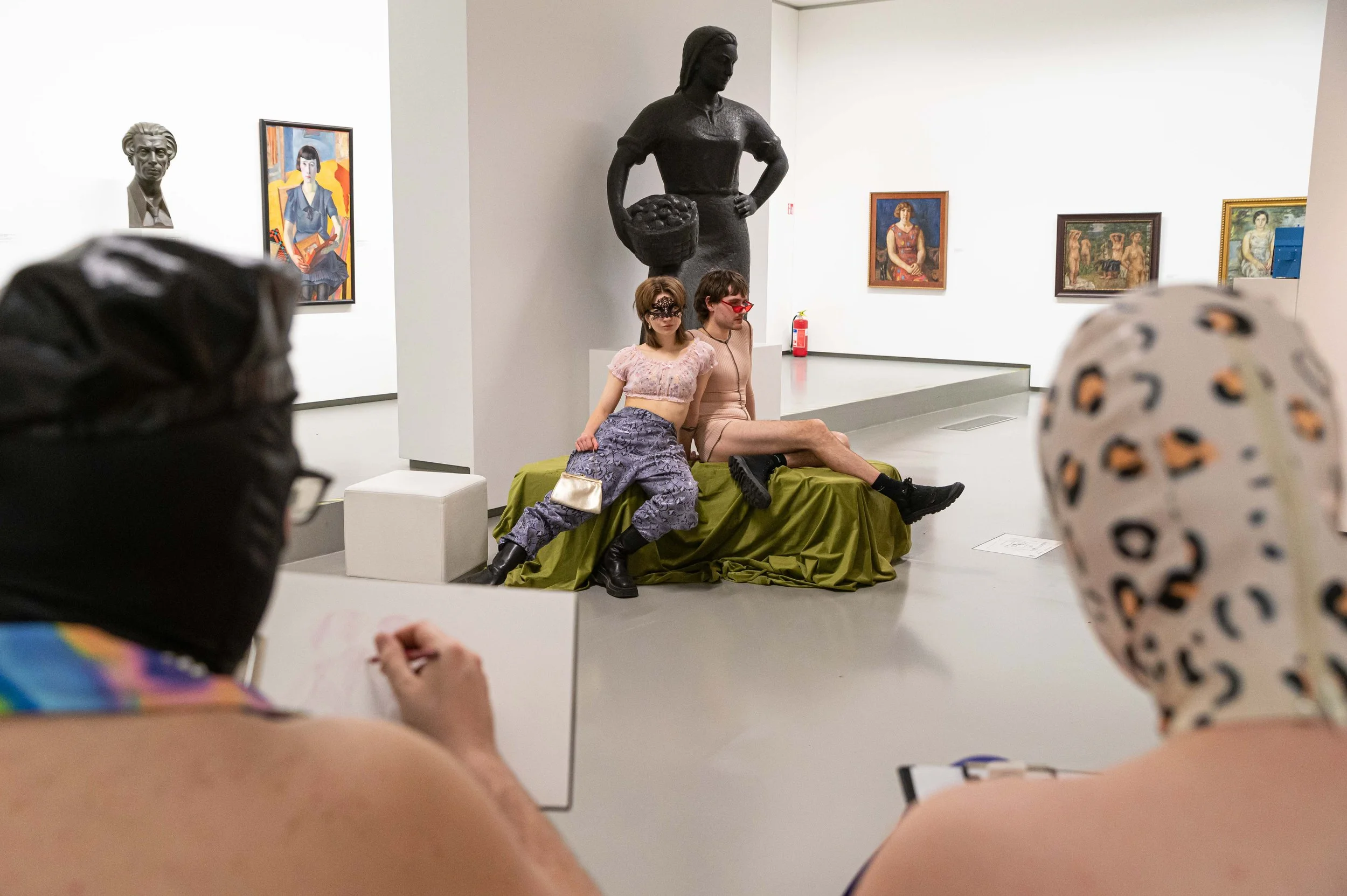
On the other hand, last year’s live drawing/cross dressing workshop ‘draw me like one of your french grrrrls’ by Edvinas Grinkevičius aka Querelle, which you initiated, helped reassess the potential of the NGA to meet the needs of LGBTQ+ individuals. Edvinas encouraged participants to express themselves amidst the permanent display of Lithuanian art by cross dressing, posing for each other, and drawing each other. With some marginalised communities, the work can be slow and private, the information never reaching the public, but in this instance, the participants wanted to be visible and represented in an institutional context within a certain canon of Lithuanian art history.