
cornered imperialistic bears and forever lush gardens
by Pille-Riin Jaik
Sitting in an old social housing complex, I am watching through a dirty window an ass of a bear sculpture. There must be a reason why i always keep looking there. Consciously obsessed, i even positioned my table accordingly. Right with the view on the bear’s behind. They say it's a she-bear. I guess because it has a cub on its back. Whoever they might be, they have both climbed on the top of the fountain and stare against the walls in two opposite directions. Limited choices and claustrophobic walls that are named after famous men. A mostly empty communal park around them, named after a disappeared Jewish woman. At the foot of the fountain: twelve astrological signs showing into all possible directions. How i wish that this fountain would start revolving. How i wish i had seen this fountain work.
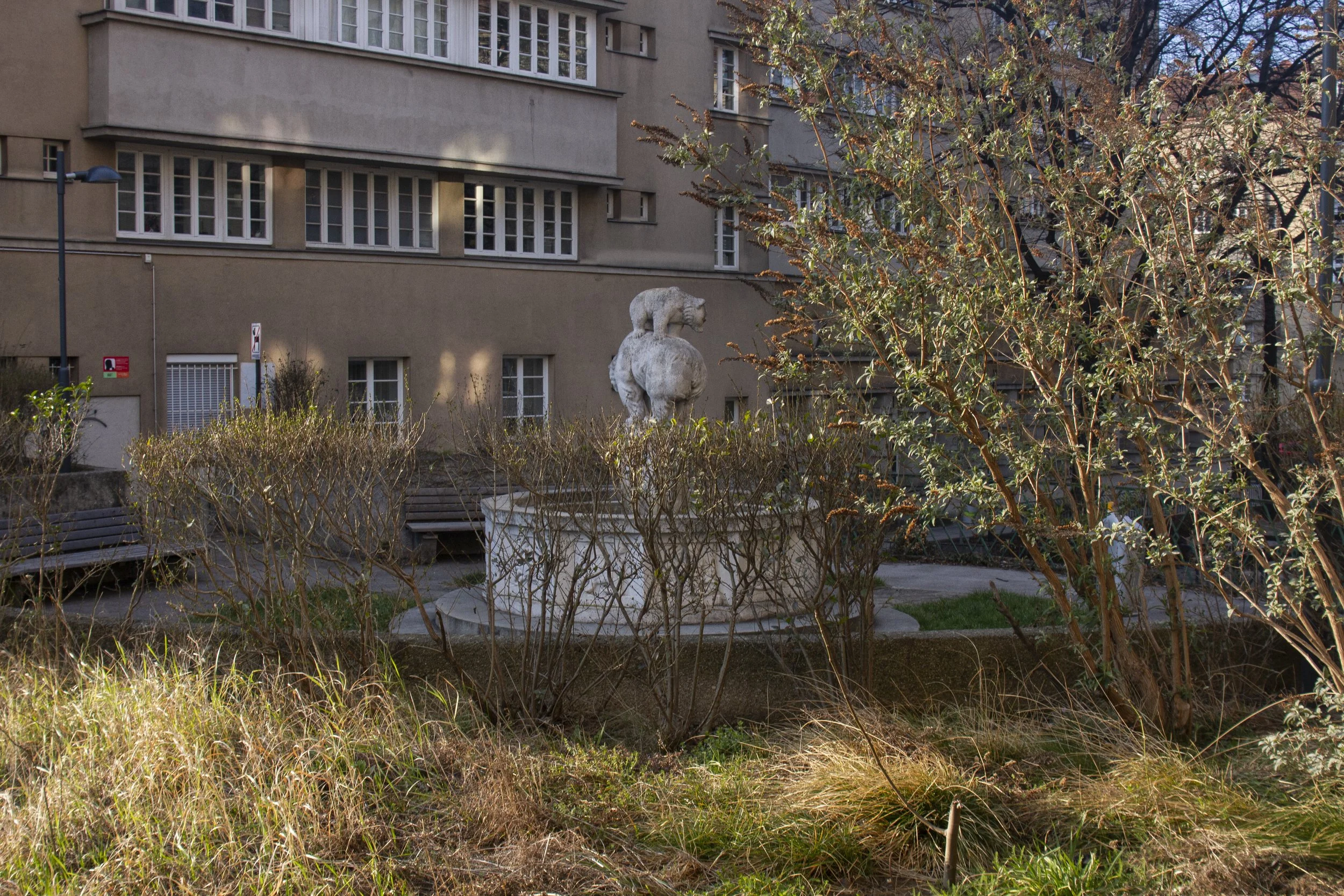
Picture of Hanna Gärtner’s sculpture ‘Bärenbrunnen’. © Pille-Riin Jaik
I feel dizzy. My head is troubled with contradictory readings. A sculpture depicting an imperialistic Russian bear. A desperate rebranding of that bear into a cute fluffy Olympic mascot Misha during the late, already falling, Soviet Union years. A generational struggle of small nations' existence in their mental and physical lands. The narratives and metaphors keep changing. I sense a massive gravitational hole at the bottom of this sculpture. Something luring but confusing from the start. The artist Hanna Gärtner was one of the first women to be accepted into the Academy of Fine Arts Vienna and yet was forced to escape to the Americas because of her Jewish roots. She took a copy of that bear to California but then ended up disappearing herself. There is this dark gap i seem to be unable to fill. The housing complex around the fountain was named after Viktor Adler’s friend Julius Popp in the spirit of imperialistic structures colliding with social democracy and the hopes of the working class. A contradiction from the beginning?
Me, identified at my birth as a woman and an Estonian, born just a few days after the collapse of the Soviet Union, staring here at the behind of this bear unknowing where the new stories lie. I hate that i can't help myself from getting too poetic. There is no left or right in nature, only cardinal or intermediate directions. This is supposed to be a political and concrete piece, but this Innenhof landscape holds too many potential narratives. I’m losing my direction. Why do the men get the houses and the women the gardens? I want to give up knowingly on this cold concrete. Are the landscapes the original places for multitudes of narratives? A forever open form of crumbled soil waiting to be told, shared and shaped into new subject matters. Over and over again. I think i am trying to reclaim the land that was taken from me. Both the fictional, that i wanted to be true and the historical that i never had a chance to know. I think that is what bothers me the most. All those lost stories, failed possibilities and broken souls. I think that is why I keep staring at this sculpture. It's all behind me and straight ahead. Knowing the sadness that i will always not know, but that there is a magnetic need to keep on looking nonetheless.
Now it is the first time i see someone playing with the bears. A mother and a daughter who keep walking in circles inside the dry fountain base unable to climb onto the top (it's taken) or interact with this dry well (it's broken) in any other meaningful way. It has now been a year* since the re-escalation of Ukrainian war with the imperialistic bear. There are some early buds forming on the branches. Spring seems still a possibility, but only inside the gardens. The statue stands firm like a dead end.
The longer i look at the bears, the more i start to see around them. A landscape that is growing, falling apart and reforming every year differently. The soil is always there and the circumstances are present. Hanna Gärtner did not only sculpt the two bears on the top, but the whole fountain and the platform they are standing on. But most importantly, she sculpted a reason for this park to remain and this park to be one day called after her name. A rich zone of multitudes in between claustrophobic concrete houses that offer the space for inhabitants to have daring games, escape walks and needed thoughts. A location that tempts historical readings and stories. A place that persisted throughout the erasure of Jewish artists' works. A place that managed to hide because it was not deemed important by imperialistic structures. A living landscape that protects forgotten stories, renderes old ones meaningless and makes the new ones sprout.
*(written in February 2023, 1050 Vienna)