
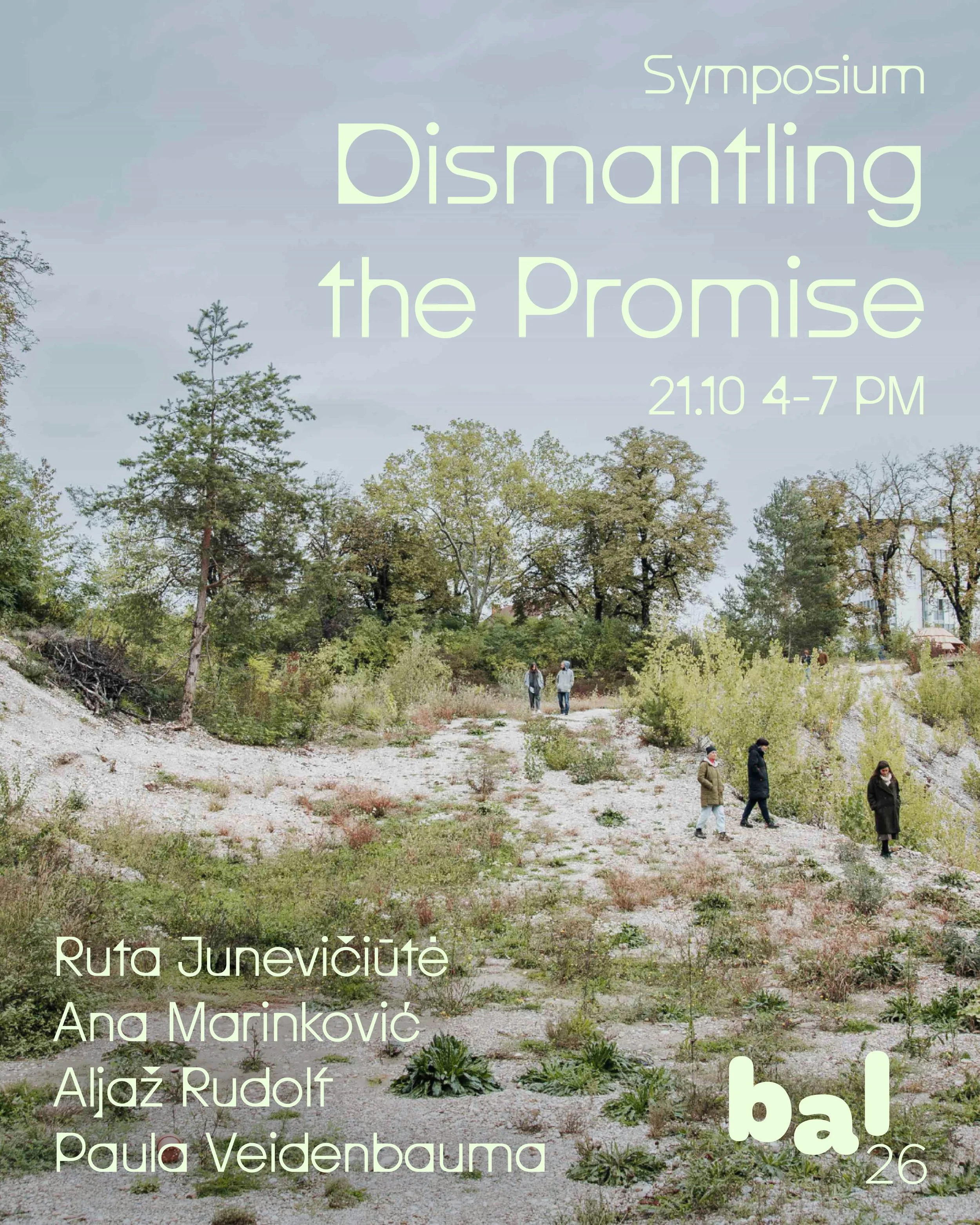
(part of bal’26)
Feminist Data as Resistance: Algorithmic Bias, Bodily Autonomy, and Digital Feminist Resistance in the Post-Yugoslav Balkans
by Ana Marinković
This talk traces a genealogy of feminist bodily resistance in the post-Yugoslav Balkans, from historical practices of gender transgression as survival strategy, through contemporary women artists using the body as a site of refusal, to feminist interventions in digital and algorithmic spaces. What did it mean, in a region of deep patriarchal structures, for some women to inhabit those systems differently? What does that inheritance look like now, when the architecture of control has migrated into data?
Ana Marinković (b.1997, Belgrade) is a transdisciplinary artist and researcher based in Barcelona. Her practice spans installation, video, drawings and critical writing. Her research focuses on contemporary art theory, feminist approaches to the body and ontology of the fold. She is a PhD candidate at the Faculty of Media and Communications in Belgrade and an affiliate scholar at The New Centre for Research and Practice.
Corridor Limbo
by Paula Veidenbauma
The lecture contributes to debates on megaproject politics in the EU peripheries, feminist corridor urbanism, viapolitics and post-socialist materiality. What forms does a compromise take when a corridor changes direction? Through this investigation, I seek to understand how a corridor becomes visible when it fails to connect, and what the material residues of compromise would articulate about the limits of European Union projection. The performative lecture takes the form of a train ride en route Helsinki - Warsaw encountering vignettes, rumours and technomaterialities of hope via Rix. Closer than expected.
Paula Veidenbauma (b. 1997, Riga) is a Vienna-based artist and curator with a background in Urban Studies and Film and Theatre Theory. Her practice, in its different articulations – fantasising, organising, plotting, making, writing, directing (...) – engages with project(ed) dramaturgies, mobility politics, conspiracies and rumour. She often works with spatial enigmas in urban political ecologies, using investigative approaches across interconnected geographical contexts. Her work has been presented at the Venice Architecture Biennale (Estonia Pavilion, 2023), Copenhagen Architecture Biennale (2021), Living Room, Athens (2024), and the Lithuania National Art Gallery in Vilnius (2026), among others. She teaches at the Estonian Academy of Arts, and co-curates gel office and portanuova performance series.
Ecologisation of Architecture
by Aljaž Rudolf
Drawing on Neils Bohr’s and Karen Barad’s quantum ontology, this project explores the philosophy-physics as a tool for reconfiguration of understanding and production of (architectural) space, shifting attention from fixed objects and/or objects in relation to intra-active, material-discursive processes.
By briefly analysing Krater’s shifting identities — artwork, natural monument, planetary site, and naturocultural heritage — the presentation will lay out the measurement—creation as production of a specific reality that can be utilised in policy-making and urban activism.
Aljaž Rudolf is an artist, architect, and researcher based in Ljubljana. Working in the artistic tandem FaceOrFactory with Eva Smrekar, his practice spans intermedia art, architecture, exhibition work, and institutional collaboration. His research explores the contemporary notion of ecology through architectural theory and artistic work. He recently completed an MA in Architecture on ecology and architecture at the University of Ljubljana.
Aesopian language
by Rūta Junevičiūtė
Taking as a starting point the historical phenomenon of Aesopian language, which was widespread in Lithuanian culture during the Soviet era, and in parts of the Russian Empire as early as the 19th century, Junevičiūtė investigates the interrelationship between generations, the gray zones of collective identity creation and the processes of (un)censoring the archives of our bodies. Following the development of her artistic research from 2018 to 2023 from more academic towards material and somatic approaches, the artist will unpack themes of transgenerational transmission of trauma and resilience, ethics of feeling the feelings and politics of pleasure as response to oppressions.
Rūta Junevičiūtė is an artist, researcher, and dance dramaturge working with visual and performing arts. In the past decade she has been researching body memory, transgenerationality and holistic processes of healing. Her work explores embodied knowledge, interrelations, oppressed emotions and uncensoring one's voice. In 2023 she published a book “Aesopica” on the social choreography of conspiracy, affects of political censorship and the phenomenon of Aesopian language. She is based in Vilnius and Amsterdam.
The presentations will be followed by discussion moderated by bal team.
Event Accessibility
We want everyone to be able to join the event in a way that feels comfortable for them. There is no one right way to be present or participate.
There are different ways to sit or stand during the event: on the floor with cushions, on chairs or a sofa, or standing.
Haptic objects, pens, markers, and notebooks will be available for anyone who would like to use them.
Snacks, tea, coffee, and soft drinks will be available. There are also places nearby where you can get food and drinks.
We will have several short breaks of up to 5 minutes, and one longer break of around 15 minutes.
You don't have to stay for the whole event. You are welcome to leave whenever you need to.
You don't have to speak, ask questions, join the discussion, or participate in any particular way. You can simply listen, observe, or be present.
If you need anything or have a question during the event, there will be a person you can approach at any time.
Please note that there is no barrier-free toilet at the venue.
A TV screen will be used for presentations. Some moving images may include sound.
The event will be recorded and the recording will be shared online afterwards. We will also take photographs for documentation. If you would prefer not to be photographed or included in the video, please let us know.
We ask everyone to follow the Improper Walls Code of Conduct, so that the event can remain a respectful and welcoming space for everyone.
Duration: 180 min.
bal’26: Dismantling the Promise
bal’26 thematic focus looks into resistance against power structures. With the title Dismantling the Promise, the program reflects on the consequences of power agreements and connections, as well as the missed opportunities for solidarity, care, and dissent when viewed from a feminist standpoint. It is an intentional look back at the power structures that constrain the autonomy of marginalised bodies and their landscapes of physical territories, social spaces, and embodied environments—turning back toward these structures, using their own tools of language, technology, and speculation against them.
The bal’26 program is perceived as an exhibition which is multilayered and denies the common structure by bringing together artworks (including research presentations) in different formats that unfold over time. Exhibition Ghost Town by forms a constant presence, while additional works: short movie (The City That Has Peace by Petra Matić), a performance (RADIO GLAS DRINE by Vildana Hermann) , a performative reading by Collective Dreaming , publication presentation (Body as an Archive: Performative Art Practices in Postwar Kosova by Anyla Kabashi and Renea Begolli) and a symposium are introduced at different moments. These function independently, yet remain in dialogue with the Ghost Town creating a shifting field of relations across the duration of the exhibition.
The selected presentations in the symposium cover problematic decisions regarding transregional via-politics of so called Baltic Sea – Black Sea – Aegean Sea Corridor stretching from the Baltics to the Balkans (Corridor Limbo by Paula Veidenbauma); investigate how weaponised digital tools are recognised and reclaimed by feminist artists (Feminist Data as Resistance: Algorithmic Bias, Bodily Autonomy, and Digital Feminist Resistance in the Post-Yugoslav Balkans by Ana Marinković), expose how city scapes and eco systems co-exist and are disrupted by political governance (Ecologisation of Architecture by Aljaž Rudolf), and explain how Aesopian language influenced the transgenerational somatic effects of repression (Aesopian language by Rūta Junevičiūtė).
During the opening of the exhibition, the bal’26 publication will be presented with contribution by Helena Aadli, Renea Begolli, Likana Cana, Hana Čeferin, Anton Goncharov, Vildana Hermann, Rūta Junevičiūtė, Anyla Kabashi, Kroplya, Diona Kusari, Ana Marinković, Petra Matić, Milica Popović, Justina Špeirokaitė, Saša Tatić, and Paula Veidenbauma.
Curated by Justina Špeirokaitė
Curatorial and editorial team: Merete Väin, Ajda Ana Kocutar, Lara Mejač, Urtė Špeirokaitė, Miloš Vučićević
Supported by BMWKMS, MA7, 15. Bezirk, Lithuanian Council for Culture, and the Lithuanian Embassy in Vienna
bal is a transdisciplinary comparative project exploring the artistic and cultural landscapes of the Baltic states and the post-Yugoslav region. Combining academic research, artistic practice, public discussion, and critical discourse, the project challenges homogenising views of Eastern Europe and foregrounds diverse identities and experiences. Through an intersectional perspective, bal examines how historical and contemporary transformations shape the lives of women and others affected by intersecting forms of marginalisation.