
(part of bal’26)
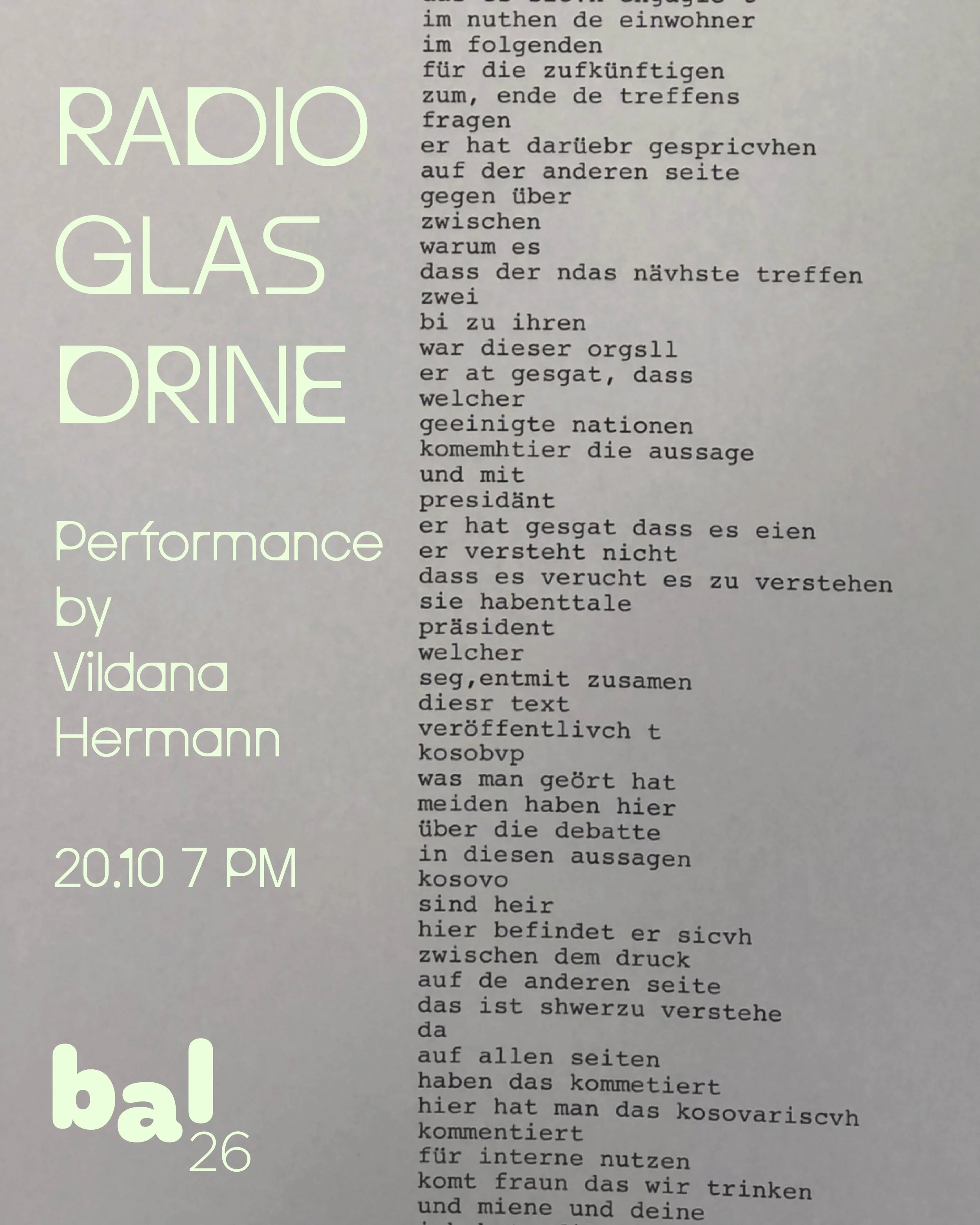
The performance RADIO GLAS DRINE explores translation as a performative practice and exposes, deconstructs, and challenges the fragility of global news transmission through the simultaneous translation of a Bosnian radio broadcast into German.
The performance continues the artist’s engagement with questions of language, mediation and transfer. Political news dissolved into advertisements, weather reports merged with turbo-folk charts, and statements slipped into noise. Translation became rupture. This project continues that investigation through the encounter between Bosnian and German, placing two linguistic and cultural contexts into direct relation. At its core, the work raises the question of what — or whom — can still be trusted when information is constantly mediated, transformed, and circulated.
By exposing these mechanisms, the performance reflects on the circulation of information, the construction of political narratives, and the unstable terrain between language and understanding. The resulting text operates simultaneously as a report and a disruption, revealing how narratives are mediated, transformed, and continuously negotiated across languages and contexts.
Informed by experiences of living between Bosnia and Herzegovina, Germany, and Austria, RADIO GLAS DRINE approaches translation not as a neutral act but as a situated practice shaped by linguistic gaps, personal histories, and the realities of diasporic life.
About artist
Vildana Hermann grew up in Živinice, Bosnia and Herzegovina, and later immigrated to Germany, where she continued her academic path. After studying art, comparative literature and art history, she is currently studying in the Department of Art and Time-Based Media in the class of Constanze Ruhm at the Academy of Fine Arts Vienna.
In 2023, she was awarded the Deutschlandstipendium. In 2024, she was a finalist for the Zvono Prize, an award for emerging artists in Bosnia and Herzegovina and part of the Young Visual Artist Award (YVAA) network. To date, she has received the Film- und Mediennachwuchsförderung Rheinland-Pfalz twice. Her work has been presented internationally, including in Sarajevo and Seoul.
Working across film, installation, sound and text, her practice investigates migration, fragmented narratives, and the political inscription of space. The simultaneity of vulnerability and immunity within post-war topographies forms the framework of her artistic research. The prefix “post” recedes in favor of an autonomous present — her focus lies on the conditions of the here and now, questioning how possible such a present truly is, and the threshold at which it begins to shift.
She understands places as political repositories, reading them through architectural surfaces, social hierarchies, and sound. Drawing on biographical and familial narratives, she moves between documentation and fiction, questioning the instability of memory, transmission, and the present.
Vildana Hermann lives and works between Germany, Austria, and Bosnia.
Duration: 90 min.
bal’26: Dismantling the Promise
bal’26 thematic focus looks into resistance against power structures. With the title Dismantling the Promise, the program reflects on the consequences of power agreements and connections, as well as the missed opportunities for solidarity, care, and dissent when viewed from a feminist standpoint. It is an intentional look back at the power structures that constrain the autonomy of marginalised bodies and their landscapes of physical territories, social spaces, and embodied environments—turning back toward these structures, using their own tools of language, technology, and speculation against them.
The bal’26 program is perceived as an exhibition which is multilayered and denies the common structure by bringing together artworks (including research presentations) in different formats that unfold over time. Exhibition Ghost Town by forms a constant presence, while additional works: short movie (The City That Has Peace by Petra Matić), a performance (RADIO GLAS DRINE by Vildana Hermann) , a performative reading by Collective Dreaming , publication presentation (Body as an Archive: Performative Art Practices in Postwar Kosova by Anyla Kabashi and Renea Begolli) and a symposium are introduced at different moments. These function independently, yet remain in dialogue with the Ghost Town creating a shifting field of relations across the duration of the exhibition.
The selected presentations in the symposium cover problematic decisions regarding transregional via-politics of so called Baltic Sea – Black Sea – Aegean Sea Corridor stretching from the Baltics to the Balkans (Corridor Limbo by Paula Veidenbauma); investigate how weaponised digital tools are recognised and reclaimed by feminist artists (Feminist Data as Resistance: Algorithmic Bias, Bodily Autonomy, and Digital Feminist Resistance in the Post-Yugoslav Balkans by Ana Marinković), expose how city scapes and eco systems co-exist and are disrupted by political governance (Ecologisation of Architecture by Aljaž Rudolf), and explain how Aesopian language influenced the transgenerational somatic effects of repression (Aesopian language by Rūta Junevičiūtė).
During the opening of the exhibition, the bal’26 publication will be presented with contribution by Helena Aadli, Renea Begolli, Likana Cana, Hana Čeferin, Anton Goncharov, Vildana Hermann, Rūta Junevičiūtė, Anyla Kabashi, Kroplya, Diona Kusari, Ana Marinković, Petra Matić, Milica Popović, Justina Špeirokaitė, Saša Tatić, and Paula Veidenbauma.
Curated by Justina Špeirokaitė
Curatorial and editorial team: Merete Väin, Ajda Ana Kocutar, Lara Mejač, Urtė Špeirokaitė, Miloš Vučićević
Supported by BMWKMS, MA7, 15. Bezirk, Lithuanian Council for Culture, and the Lithuanian Embassy in Vienna
bal is a transdisciplinary comparative project exploring the artistic and cultural landscapes of the Baltic states and the post-Yugoslav region. Combining academic research, artistic practice, public discussion, and critical discourse, the project challenges homogenising views of Eastern Europe and foregrounds diverse identities and experiences. Through an intersectional perspective, bal examines how historical and contemporary transformations shape the lives of women and others affected by intersecting forms of marginalisation.