When the words are insufficient, the body speaks
Interview with Tatiana Kocmur
by Ajda Ana Kocutar
(Interview took place in 2024)
Tatiana Kocmur’s body of work is a versatile one, with deep care for the other at its centre. It stems from her lived experience, a trauma of her own which led her to develop a practice that seems to aim for some form of transformation every time she develops a new project. It can be a therapeutic process and it is an artistic language she has been developing from her beginnings as a painter through many different collaborations which have rooted her in performance art. Her fascination with the potential of the latter doesn’t stop with her own performances. She digs deep into their history and how specific works were perceived in their time and space, highlighting their uniqueness. She is also active as a producer, cementing her commitment to art in the broadest sense and contributing greatly to Ljubljana’s art scene.
You began your artistic career as a painter, how did the transition to performance happen? Both in your painting and in your performance practice you focus on the body. Partly from a personal perspective, on the other hand, you're concerned with the broader issue of the exploitation of the (female) body, its limitations and constraints, and the issue of violence. How do you navigate between painting and performance in this sense?
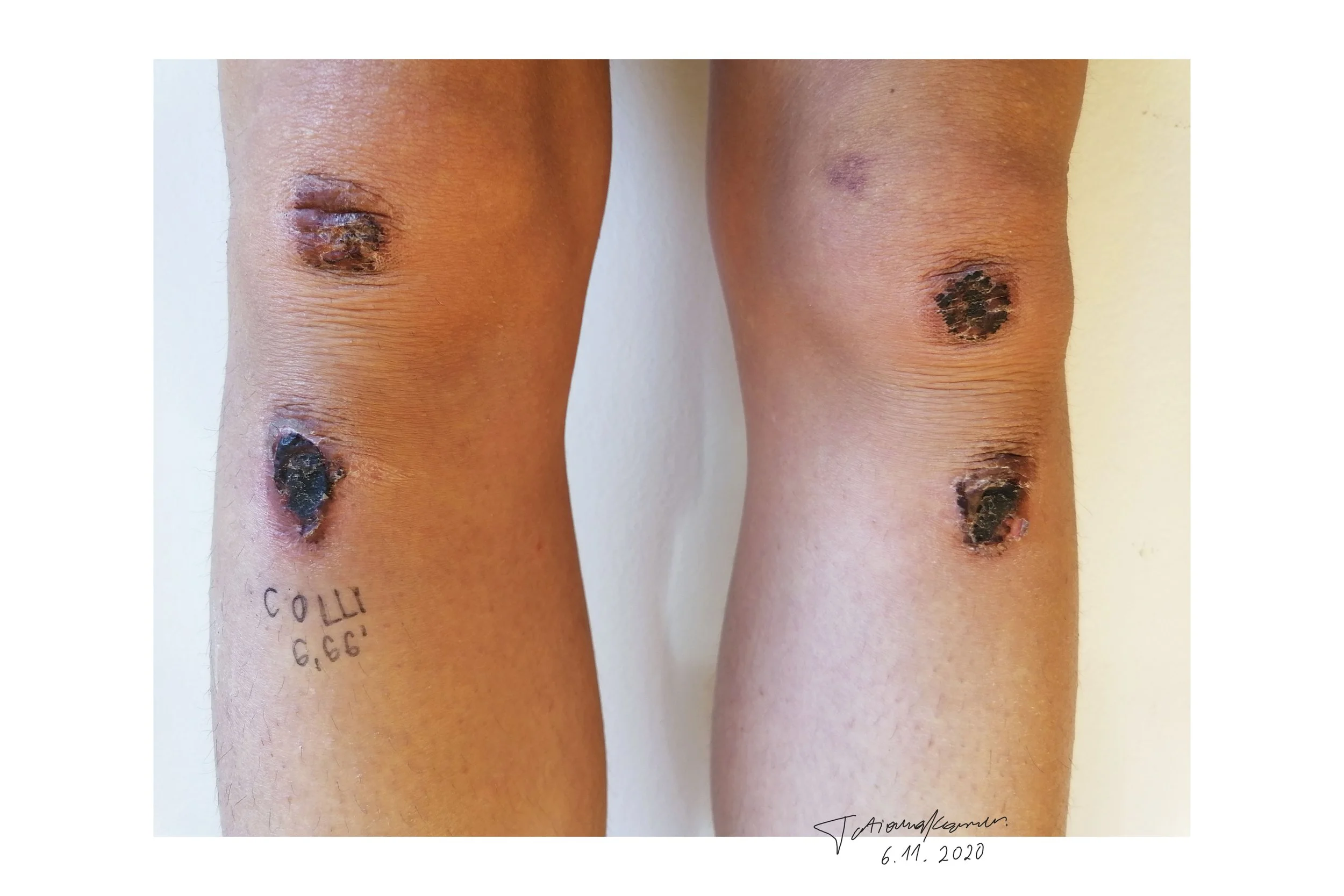
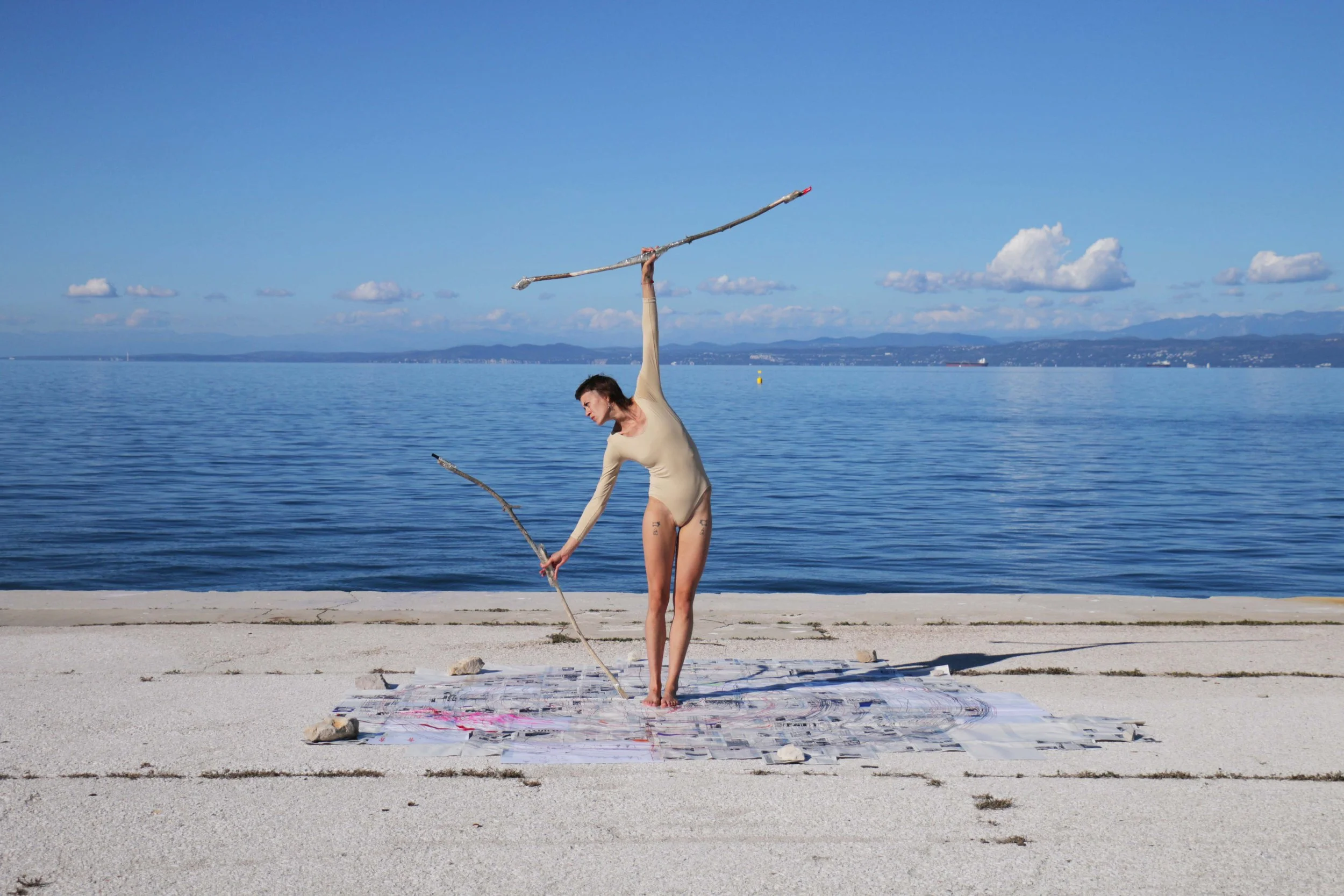
I studied painting and from the very beginning, I was mainly interested in figurative work, especially women's bodies. I was interested in the representation of the female body in relation to its surroundings and the question of the ideals that are prescribed to us, how we should act in accordance with them, and how we are situated in the space in which we live. A radical change happened when I got sick and was diagnosed with an autoimmune disease. I was going through a very stressful, emotional period. It turned out that the illness was a response to that, to the turmoil inside me, and there was nothing I could do but calm down, get in touch with myself, and explore what was working for me and what was not. What is it that I need in order to live as healthy and relaxed a life as possible. All this is linked to my experience of immigration, which I have been hiding from myself for a very long time, distancing myself from it. I didn't want to deal with it, it was traumatic. In a way, I distanced myself from myself, which was reflected in my substance use, among other things. These were ways of silencing my inner instability. The autoimmune disease was therefore a warning from my own body. In this way I started to think of the body as something that is of course very important, we all have it, it is our connection to the outside world, and without it we cannot function properly. Then my painting of bodies started to connect with finding balance within myself and that's when I made my first performance, which was about self-healing and dealing with my own problems. It worked as a process of acceptance, which I sought through this medium of expression. Performance is about exposing one's own body to the audience and in that sense it is the most direct way of communicating bodily processes. So I distanced myself from painting, from the actual production of paintings, even though my background in painting is always visible in my performances in terms of visual language. I call my work living images, a kind of tableau vivant, even though I'm not reviving old masterpieces, but showing moving images that usually deal with different social issues, more difficult issues like sexual violence. A context in which the body is put to some kind of test, put in difficult situations that transform us. I'm interested in the transformation that happens inside us when we face trauma and how we deal with it. It is difficult to control and difficult to accept. So, indirectly, I am working on accepting myself and understanding that things happen, that we cannot change the past, and that we have to find the best mechanisms to live calmly.
How do you see the relationship between painting and the performative aspect of your practice at the moment?
I keep thinking I want to go back to painting, I keep having ideas for paintings and for creating in this medium. But life evolves in its own way. Painting takes up a lot of my time, and a precarious life requires a lot of work to live normally. This reduces the time for contemplation, for research, and in this situation, I haven't found myself yet, I haven't found the possibility to paint. But it's also true that it's difficult, maybe because of my studies, painting is a struggle, the process is stressful, and I'm always wondering why I'm doing it, how I'm doing it, and who will find it interesting. In this context, I have several doubts. So I'm torn about it. I really want to paint and I think about it all the time, I also feel like there is some potential in my painting that I could develop an interesting language, my paintings so far seem good to me. I could grow as a painter and I want to, but at the same time, I feel fear and reluctance. Every time I start to paint I feel a certain awe in front of the canvas. I have to get over that if I want to keep painting.
Perhaps the painting is also more overwhelming because it remains unchanged and present once you have finished it. Performance, on the other hand, is more ephemeral, you can document it, but it passes as it is.
I agree that there is something to that, but at the same time the problem is also practical - lack of storage space. I like to do large-format paintings in general, and the biggest format I've done is still in a box and nobody sees it because it's too big for my circumstances. I should go to the gallerists and work more on getting these paintings seen, but even that is challenging in its own way.
In Red Threads, you and Francisco Tomsich explore performance art in space and time, with perception, memory, and narrative as key elements. What are some of the findings of your process?
We started this work in 2018 and what we were interested in were people's memories of performances. It really is a one-off thing, it can be repeated, but it will still never be the same. Every time it's about some new experiences and interpretations, it's about where it's performed, the audience, the feeling of the performer - all these things influence the performance and make it unique. We focus on the people's experience, we choose the performance and we look for the people who were there. We collect people's memories, narratives that can be contradictory, and through that, we trace the nature of remembering, the imagination that happens when you are captivated by something, and as a consequence a memory is formed, which may differ from person to person. At the same time, our work is also a way of documenting and historicizing performance art in a way that follows narratives, and we help ourselves with documentation, photographs, and videos.
Do you see your own performance practice differently through this prism?
I started thinking a lot about how to document my own performances. Again, it's a contradiction - why document something that doesn't actually want to be constrained in that way? On the other hand, there is probably a human desire to contain something that happens, because performance has the power of transformation. I've been thinking a lot about how I could store this uniqueness in a format that could be visible to others later. So that it doesn't just remain as documentation so that it's not just a collection of photographs and videos. I also use many other elements in my performances, from painting to theatre, sculpture, and costume design. It seems to me that all these elements store a memory and that the material itself can trigger it. I'm still a visual artist, I exhibit in galleries, and it's in my interest to be able to present my practice post-festum in a way that's not prosaic.
In your performance, The Following Body, language, or the absence of language that corresponds to pain and trauma, plays an important role. It is based on the testimonies of people who were abused in their youth. How did you deal with the inability of language to address or even process trauma in the performance?
I draw mainly from my own experience and it happened that a loved one shared her traumatic experience with me, I was the first person she told. It is a trauma that is unimaginable. It is also traumatic for someone to keep something like that inside for so long due to post-traumatic syndrome, fear, or self-protection. It is very common for silence to prevail. Her telling me about her experience made me think about the inability to speak, but also about the lack of a safe space and the lack of support when the victim decides to speak. Reporting procedures are difficult and add to the silence - which for many is automatic. I started to think about what silence does to a person who is holding in suppressed distress and what is happening in the body. I wanted to show the inside of the body on the outside, which I did using different visualisation methodologies that were successful not only for the work itself but also for the interaction with the person who had experienced the trauma. It proved to be a very therapeutic process. The main thing was therefore to visualise hidden and ineffable inner feelings, which are very abstract and difficult to put into a concrete form.
Before this project, you have also dealt with your own painful experience in other works. Do you feel that this was necessary for you to address pain and its expression more broadly? How do you view these works in relation to each other?
It seems to me that someone who has had their own traumatic experience can perhaps understand other people who are dealing with pain more easily. I can also say that I have a certain empathy and that I am quite sensitive and perceptive. I probably would not have come to this without my own experience. In this sense, my practice is increasingly becoming a kind of therapy for relaxation, self-reflection, and healing in a non-medical way that can have great success. I am very interested in art therapy.
You attribute much of your pain to the experience of emigration and immigration, to the dynamics that shaped your childhood. Language is certainly a big part of that. How do you look at your experience in hindsight and after the reflection you have already done?
This is what has shaped me. I am the person who had that experience, without which I would not be who I am today. It was a very difficult time, full of pain, misunderstanding, and loneliness. A total change and loss of identity in childhood, with many consequences. A period of instability and a process of recovery that is long and painful. I consider myself to have been born three times so far. The ground is knocked out from under you, and as a child, it is difficult to understand that and to find the right mechanism to put the pieces back together. I myself only now feel that I accept these circumstances, that I feel good, that I feel belonging. But the language is ... [laughs] Slovenian is very difficult. I can say that for sure, even though I have known it since birth. But it's different if you speak it somewhere else, you don't use it every day, you don't hear it. I landed here and I didn't understand anything. It was like starting all over again with the language.
Do you think that your artistic journey and the search for your own expression have helped you to put down roots again?
Yes, definitely. We are all looking for our own way of expression. For me, verbal communication is difficult, I think also because of the immigrant experience. I never feel safe speaking. But it's also true that in a way I'm a typical artist. I loved to create as a child and wanted to be a painter, so this has always been my language. Although I didn't think of art as a healing and a way of processing hardships at first, it just happened. In the beginning, as I said, I was running away from myself, but it was necessary to get in touch with who I am.
Much of your work is made in collaboration with other artists. What is it that drew you to collaborative work? Where do you see its greatest strengths?
I actually started my practice with collaborations, usually in pairs. They all grew out of friendship in a way, and for me, it's very important to have a personal relationship that builds collaboration. I feel safe in that. In the beginning, I was full of doubts, now less and less, but when you are in dialogue with someone you value and appreciate their practice and share knowledge, spend a lot of time together, and share your world views, it makes the process easier. The less you struggle with issues, the less chance you have to get caught up in them. I am only now doing more independent projects and if I work alone I get caught in loops sooner, there is more stress and uncertainty, which is otherwise resolved in dialogue with the other person. You get to know the other artist intimately and learn a lot in a very informal, healthy, and friendly way. That's why I keep coming back to collaborations, even though I've had bad experiences with them. You mustn't be naïve about it.
In your latest co-authored performance Rastišče, you address the community through the idea and form of the mycelium. What gave you the impulse to turn to the exploration and artistic interpretation of the subterranean growth? What do you think we as a community can learn from this?
All the participants share a fascination with nature. This exploration was initiated by Berlin-based performance artist Tis Aly. We wanted to show a non-hierarchical way of working together or exchanging raw materials like mycelium does in nature - it makes sure that the flow of raw materials reaches different organisms. The background is a reflection on non-hierarchical networking as the best way to mediate and coexist. It is a poetic way of such cooperation, less focused on scientific demonstration. All the participants, who are working in different fields, wondered how we could collaborate and follow the mycelial principle in this meeting. The process was very beautiful, although at the beginning I wondered if our method should be more scientific. But none of us is a bio-artist, none of us is an expert in this field, but we can apply this principle of coexistence to what we are primarily doing.
You also work as a producer in the artist-run project and exhibition space Cirkulacija 2 in Ljubljana. How has this work influenced your artistic practice so far?
My collaborations have led me to an interest in different artistic practices and a desire to bring artistic ideas to life, to help artists to present themselves. I started producing in 2018, and through this experience, I have gained a better understanding of the system, its requirements, and how we can realise our projects within it. I've gained a lot of knowledge about applying for calls, negotiating with funders, etc. But I've also learnt a lot in terms of my practice, especially about networking, co-production, and how to most easily produce something that would otherwise be challenging. Of course, this work is not easy. When I became a representative of Cirkulacija 2 I came to realise how much time it takes me and I had a crisis where I wondered if I was going to stop being an artist because it was putting my practice aside. I want to be an artist, I don't want to let the production work take over for the time being.