See the world made out of curves, curves instead of words*
Interview with Aistė Ambrazevičiūtė
by Kata Bitowt
Introduce yourself.
My name is Aistė Ambrazevičiūtė. I present myself more boldly now as an artist and architect. The transition from architecture to the arts was not easy for me and every time I’m asked to introduce myself, I think the best answer is: interdisciplinary creator, because every day my title, status, and scale change, very flexibly, depending on the projects and the environment. Just like my lichen practice – I also change and adapt.
It seems very important for us to say: I am this and not that, and it’s interesting how lichen appears already in your introduction, as a symbol of flexibility.
This is both the result and the conclusion: when you delve into a topic during the research, you become the object of your research yourself, willingly or unwillingly. This is exactly what happened to me. Now that I have gotten to know the ecosystem of organisms better, through the tools of science and art, I seem to see very similar methodologies everywhere in my personal life. [laughs] I keep comparing.
It's probably human fate to look for patterns and compare them.
It really is. I've been looking for answers in the human world for a long time and haven't found them. Then I came across the world of imagination and lichen.
The forest is very present in your work as a multi-species organism, ecosystem, and communication system. There are also a lot of lichens. When did you as an artist or an architect turn to nature, forest, and lichen?
After my bachelor's degree in Architecture [in Lithuania], I found myself in an architecture course at the Academy of Fine Arts in Vienna. It was completely different from what I was used to. It completely broke with the standards of architecture and spatial thinking. (...) I was introduced to biomimicry, organic architecture, architecture without architects, etc. The whole world of natural architecture came into being. (...) My master's thesis was about wooden architecture. [Before] I worked in Lithuania for a few years and I experienced the non-contextuality as well as the devaluation of wooden architecture there. But when I got to Vienna, within a year, I had created a very strange project about wood, approaching it from a different angle, where you don't even understand, whether it’s a tree, a mushroom, or a cosmos. At that time I was really getting very clear about what I was interested in, and all my methods came about, which I still use now. I found ornamentation in the anatomy of wood, and I got hooked on microscale and biology: studying the different properties, types, and parts of wood through a microscope. The project was called Imaginary Folklore. I couldn't believe how many innate properties wood has that are not questioned. How much fantasy and imagination lies within it. That's where the love for such unexplored fields in architecture began. The questions of how you can work through space and with space, not only in reality, not only in conventional practice but also somewhere else, on other scales. Then I learned to model non-straight shapes and non-straight lines. During my master's degree, I was studying all the parts of a tree, not just the wood, but everything around it: the bark and the fungi. One day I found lichens and their different organic forms under a microscope and I knew, probably subconsciously, that I wanted to pursue something with a smaller scale, a smaller object, a smaller name, easier definition, smaller focus somehow. During my PhD I realised that I needed to bring my hobby, my interest, which was very private, closed, exclusive – lichen – more out into the public domain, so that it could be shared. I very quickly decided that this should be the thesis, the narrator, through which I would talk about different topics.
What is natural architecture?
Architecture that is not man-made.
It's interesting how we try to find man-made things in nature. That there is ‘architecture’ in nature too.
Yes, I think these concepts are very appropriate for learning, because I learn through nature myself, from nature. Naturally, then, the philosophy is that of the forest. It’s forest architecture.
You said that the narrator through which you speak is lichen. It seems that from an artist's perspective, you're not trying to express yourself through the lichen, but the lichen expresses itself through you. What is the relationship between you and the lichen?
The relationship is quite difficult to define. It depends on the context. I don't want to call myself a lichen, but as I said, I feel that connection very strongly. And it's probably not for nothing that I chose that topic, because I do often see my actions becoming scientifically similar to the methods of the lichen world. You become the object of your own research, albeit figuratively, and indirectly.
Still, when you say that the lichen is the ‘narrator’, there is some communication, some interaction. How do you communicate with lichens?
Well, I just need to surround myself with them. I'm in Nida now and this place became a research observatory for me. There is a rich diversity of lichen assemblages, communities. For me, there is probably no other way to communicate. The relationship is already built. [laughs]
Sounds like an infinite friend, because lichens are probably everywhere, right?
That's why I liked them. In the beginning, it seemed like an object that was less visible, less recognisable, but they are absolutely everywhere. Maybe some species are more prominent than others. Now I am no longer surprised by their diversity. It's more interesting to see the other characteristics and the overall compositions. It's interesting to be surrounded by forest architecture and to see lichens growing in all sorts of unpredictable places, shapes, and surfaces. It encourages, deepens, and simply continues communication. What can be found in the environment is constantly unpredictable.
It should be noted that lichen is a symbiosis of different algae and fungi.
Different algae and fungi, as well as bacteria, yeast, and maybe even viruses.
An ecosystem in itself! What can we learn from lichens? Why are they worthy not only of study but to be interacted and communicated with?
Initially it was simply their being visual and abstract that impressed me. That's what's so appealing, that something can be that and only that. That's what I was aiming for – a feeling. Not many people know or understand lichen, but if they see a beautiful overgrown branch or bark, they take a picture and share it. I was hooked by that, but after observing for a little longer, it was the comparison of different contexts and how different species grow in different places that fascinated me. How the growing conditions affect their shapes and diversity, and I was dazzled and enchanted by the indescribable diversity of shapes and how sensitive they are to their environment. That's what I was looking for and missing in the architectural context. I thought wow, this is where I could learn, what I would like to follow and observe, how they grow in spaces, and how they grow according to contextual conditions, climate, and geography. To observe architecturally, how the lichen assemblages become reliefs, surfaces, and sculptures in the forest, the city, and everywhere else. It was just very interesting to learn about those spatial qualities and contextuality. Even scientists can't predict what will be the shape of the lichen, or what determines it. These are organisms that are constantly mutating and adapting. It fascinated me so much that not many people actually know about lichen, there are still no answers. Then, for an artist, there was a medium to create your own answers, your own theories, your own visions. It's a very wide and interesting field.
I imagine people study plants by dissecting them: here is a berry, here is a flower, here is a stalk – everything is very clear. They then categorise them into kingdoms and hierarchies, and, lo and behold, we know something! We have named it and now it is part of our world. We are done. Although, in reality, we don’t have a clue about how that organism coexists and communicates with other organisms. How did you approach it as an artist?
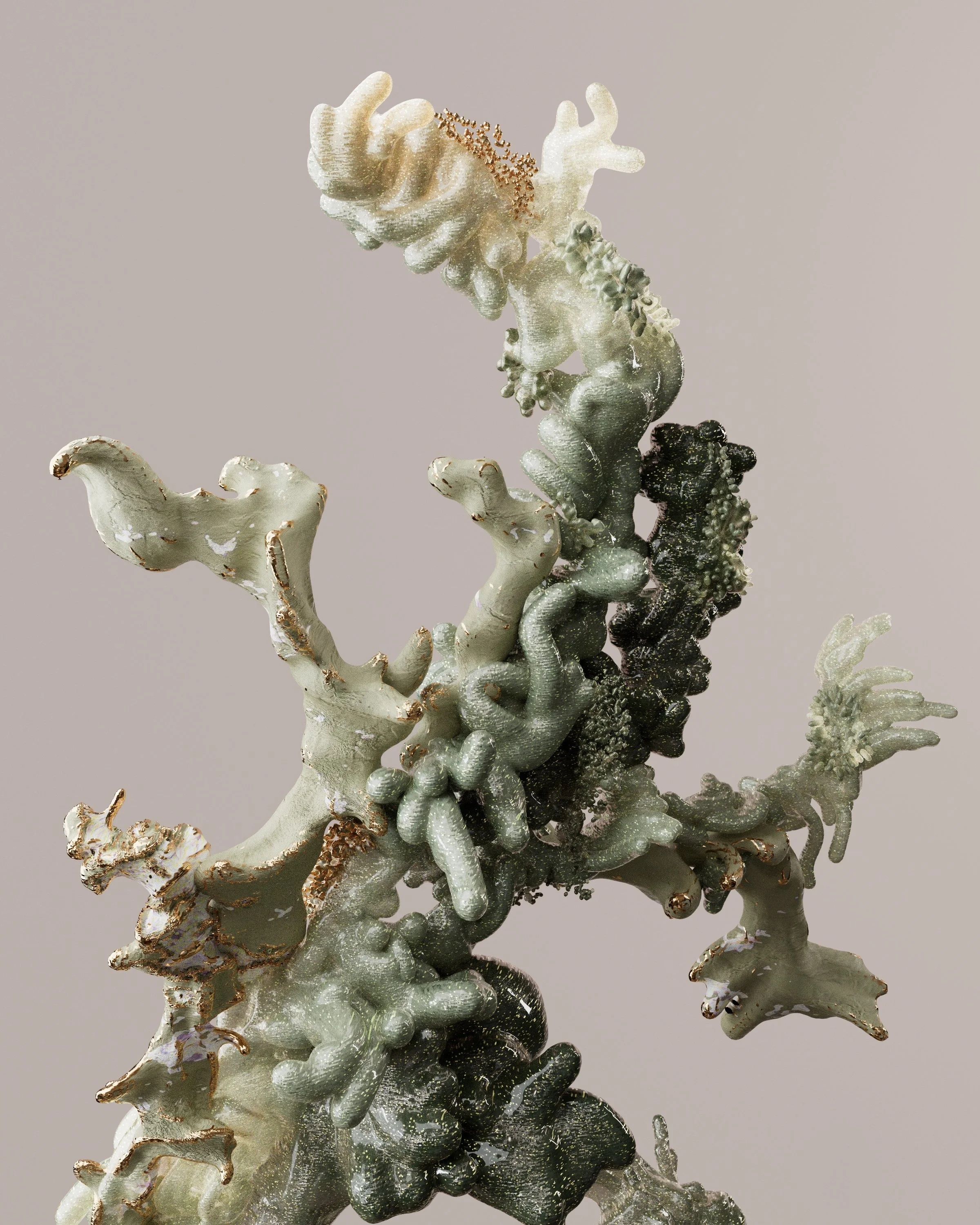
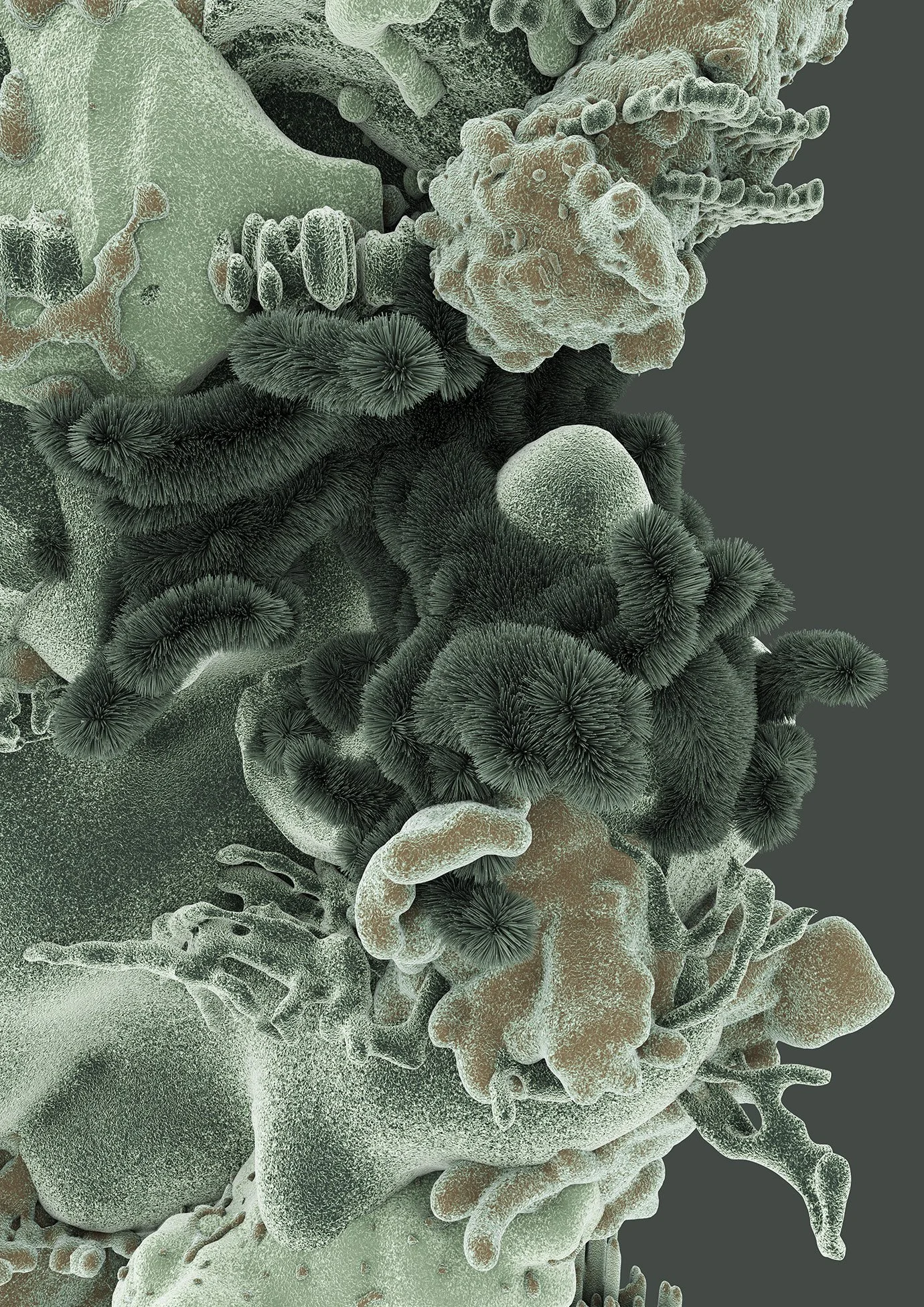
That's probably the very beginning, learning to speak by copying. But I didn't even manage to copy, I just listened and looked, I observed and I didn't copy. It was just very interesting to have the visual language of the lichens next to me all the time and to be in the midst of it. What I have discovered is that even forms like non-spatial form, digital form, and illustrative form, can tell a lot. They can suggest a lot of themes and open them up. That's what surprised me too, that sometimes these words, these images can be very small, like lichen, starting from a very small scale and growing into something much bigger. I also learn from the lichens about the different scales, how to be in the interdisciplinary field, and not be afraid of the very small scales, and small intentions. Lichen gave me the courage to create imaginary shapes because I realised that whatever I create probably already exists in reality. The thing about the lichen world is that all the mathematical shapes seem to be valid and can be found in nature. You draw them first, but then you find them in nature, back and forth. I realised and saw in practice that this diversity of forms already existed somewhere in nature. I wanted to emphasise that diversity and so I created hybrid plants and forms to illustrate that everything that looks fake can be real.
Does the artistic approach give you an advantage when dealing with nature?
It seems that there needs to be a symbiosis between science and art. It might be more difficult to find, at least in my field, scientists who also understand the artistic approach, and it takes quite a bit of freedom and flexibility to understand it. I am following science news and looking for answers. Just like in different artistic fields, I am looking for inspiration and different knowledge in science. Structure and categories are also very important because as an artist you have to break something. If there are no categories, there will be nothing to break, to invent, or to offer. [laughs]
It's kind of a lichen answer that everything needs symbiosis because it enables something new to emerge. Tell us about your PhD project Lichen Grammar. What is it and what did you learn during this research and project?
It is inspired by several books. One of them is The Grammar of Ornament, which I studied during my architectural studies. It’s about ornamentation in different cultures and it mainly illustrates how different cultures visualise the environment differently. I realised while I was studying lichens that it would be very interesting for me to create a kind of set, highlighting how different contexts create different ornamentation, and that's how the name Lichen Grammar was born. I wanted to create a kind of interdisciplinary book, a compilation of how lichens see, how I see the environment, different contexts, and the imagination that comes from observing their surfaces, shapes, and textures. I was in different residencies [during the pandemic] where I could be surrounded by lichens. That was the goal – to be in different places where different lichens are growing, to explore them for a longer period. And that's really how a lot of unusual stories were born, stories that I learned to not only visualise but also put into words, which is probably a big challenge for many artists. Decorative language became another tool. It was interesting to experience the non-visual side of my practice.
What is decorative language?
In my visual practice, I'm always focusing on textures and details, so I wanted to speak similarly with words, to speak decoratively. That's how I express decorative language – quite visually.
Visuality and language are also separate arbitrary categories that we've somehow created.
Yes. I never had to write as much in my studies as I've had to write in the last year. The study of artistic research is also a very uncertain field with an infinite number of questions, where you can invent everything yourself, both rules and form. It was really about finding your own rules and your own ways of articulating that form.
You’ve also created a workshop called Lichen Grammar, where everyone can learn to create their own personal Lichen Grammar. What is this project?
When [during the pandemic] the Riga Biennial couldn't be physical, they came up with the idea of focusing on education. Artists were invited to present their practices through a workshop format available online. At that time I found myself in Helsinki, where for two months different artists together with mentors were looking for ways to present their practice and to get to the heart of the matter through a workshop in different forms, either a game or a story. It was a very important time for me to see myself from the outside and to tell younger people about my practice as this was a workshop for school-age children and teenagers. The workshop included up to 30 macro photos and tasks that were identical to my drawing practice. Not with a computer, but with a pencil. With the most accessible tools. The different tasks express how one sees and visualises the lichen. The trick was to make those tools and my whole workflow clear: turning modelling into drawing presenting the graphical properties of lichens. After [the pandemic], I received many invitations by schools and architectural festivals to lead lichen workshops. And it was very interesting how people immediately understood what my practice was about and what I wanted to say just by drawing. (...) It was very interesting that over time, the lichen workshop has been attended by everyone from babies to professional architects and it had some impact on all of them.
When the word ‘grammar ’ is in the project name, it seems that there has to be some kind of linguistic component, written word, some kind of sign. But again, it’s an arbitrary categorisation limitation, because language can be, as you say, just a 'translation' of what you see into visual form.
Yes. The most interesting thing to me is how people are used to looking for rules and answers from a very young age. How a blank sheet and open tasks are unsettling. It's also immensely interesting to observe how we seem to be born already formed and how long it takes to free ourselves.
It’s a paradox because you're saying that it's so hard to be liberated from rules and definitions, and yet it is important to be defined, and to be delineated.
I need to define myself because otherwise, it's very easy to get lost. Yes, absolutely. Even grammar, as you say, creates some categories. I also self-define in a certain format, in a certain rectangle, like the screen, like the surface, there are still some guidelines, rules, and constants. I find that I'm always on both sides.
Of course, man is not the opposite of nature. We are a form of nature. Maybe our form is one where we have to categorise everything and that's how we get to know the world. But it seems that through your project you have found some other way of seeing. Lichen Grammar teaches you to create your own grammar. Why do you need that if the function of language, of grammar, is communication with others?
Your own grammar, your own language, your own voice – that's what it's about. Not following someone else's rules, categories, and grammar, but finding your own language. When we talk about Lichen Grammar, the question often arises: is it the grammar of lichens, or is it also the grammar of Aistė? Because again, I am the interpretation of how I see lichen. But it is an artistic project, an artistic form, just another suggestion, putting something on the table, offering another way, another language, and not denying the others. And I see that in the context of ecological themes, this is very important. Just as lichens themselves are scientifically a compound, so, as we say: ‘in the language of lichens there is no I and there is we’. It's that reacting, communicating, and collaborating, with different people, with different projects, with different languages and categories that changes. This is in no way my own language, it’s a joint project. [laughs]
Our vision is very limited, we don't see the myriad microorganisms and bacteria around us, and so we are not aware that they exist. Is it possible to go beyond those limits, to change the way we learn to see or imagine? Maybe those limits are not even limits?
I think I've long since moved beyond those boundaries and created a lot of new ones. Watching the lichens, observing myself create and how intertwined creation and seeing are, and that things move in an incomprehensible sequence, how the subconscious knows before it sees it, etc. It seems to me that everything around us is magic. I want boundaries sometimes so that it's not too hard to feel and to live through so many of the layers and questions that arise from observing that uncontrolled context. It's actually like AI, nature seems to be without boundaries. It can probably be both puzzling and frightening at times. [laughs]
I am under the impression that humans are limited and nature is the opposite. Although we are also nature and probably other organisms are also limited in their own way, maybe that’s not bad, except that we're about to destroy the planet because of our limitations. But anyway, as part of nature, it's probably okay to be limited, no?
I think that's where the creativity comes from. That's how the lichen came about, because of the limitations. Just a collective that helps each other. It breaks those limitations.
And adapts to any context.
Yes. That’s how I'm learning to adapt both to the artist's existence and to the artistic context, the artistic field. I'm learning a lot from the lichen, how to survive, how to live, how to be. In terms of finding my own language, both the lichen and the search for creativity came from a lack, from shortage, because there was no one around in the human world who would be either a companion or a teacher. I had to look somewhere else. A lot of things come out of deprivation, and scarcity. So the lichens became my mentors.