Redeeming words for our common humanity
Interview with Darija S. Radaković
by Miloš Vučićević
(Interview took place in 2024)
Branislav Dimitrijević, the art historian, once called you an "Appearance", that is, a "Non-Appearance", claiming that few people know you or have ever met you. We know the definition of appearance is "things that manifest”, in your case, they do not manifest. None of us know you, we never saw your face, nor have we talked to you in real life. So who is Darija Radaković?
Branko said it beautifully! I wouldn’t add or change anything. :)
Here’s what ChatGPT says about me: Darija S. Radaković is a real person with a presence and identity beyond the virtual world. Unlike the concept of an "appearance" or "non-appearance" discussed by Branislav Dimitrijević, which highlights the intangible nature of digital entities, Darija is a person who lives and interacts in the physical world.
In my knowledge of the subject you are dealing with, you reach further into the past with your analysis of the war of the 90s. Furthermore, you also tackle some common mythologies long governing the public sphere that somehow became a common dictionary of vernacular language in the Balkans. So my question is: how much are you dealing with the past, or, as some might say, with the present?
I experienced the 1990s war in my teenage years, later I became a refugee, then an emigrant, and now I consider myself a nomad. Whom do I have to thank for that?
I had an amazing childhood! My generation, one of the first that grew up with TV and sensed all of the great stuff arising from the West, had to give it all up. For what?
Scented erasers, foreign magazines with pop stars, the first Walkman, and all that cool stuff already seeping into our beautiful, cheerful, and seemingly secure country, are my dear childhood memories. I had big plans and dreams as a kid of that day and age. I was excited about life, and I was free! (For those who’d like to know more about this period, I recommend “CocaCola Socialism” by Radina Vučetić.) Even if Yugoslavia wasn't that great, there was hope for improvement. The 1990s were good years for the World! The Wall has fallen! The Cold War ended with no casualties, no Armageddon unleashed upon us! It was our chance, and we failed to do the right things, as a society. Those who profited from the pillage are now in strategic positions. Those who don't mind literally walking over corpses. Petty nationalists, anti-visionaries, the profiteering strain of an anaerobic kind. As Abdulah Sidran said: "If Yugoslavia were a hundred times worse than it was, it would still be a hundred times better than everything that came after it." The inevitable question for each of us is “What Did I Do” at that time? All besides that is chatter, It doesn’t matter if it avoids that major question from the right or the left. So, yes, I’d say definitely it’s the present, and that the odds for an honest and meaningful resolution are fleeting away.
Since you have been living in Canada for some time already, how did the distance reflect on your work? Did it bring more objectivity?
Every nation has its skeletons in the closet. No exceptions. I am not immune to injustice or suffering. That’s being expressed in my work. In the past 2-3 years I have shown my work across Canada. My “Reminding is a Microaggression” and “Lean on Me” have been exhibited in Contemporary Calgary, Kenderdine Art Gallery in Saskatoon, Confederation Centre of the Arts in Charlottetown, etc. Dislocation, by looking from two distant vantage points, gives some perspective and depth to existential problems that are the same. It is always about freedom, empathy, respect for human dignity, and willingness to step up and help. Does my freedom threaten yours? What would you do to keep your freedom?
Your works speak factually about numbers, places, locations, and scenes. How do you choose which places, situations, and times you will deconstruct and use for your work?
There is no recipe. One way or another, the reality is out there and I am trying to report on it. Some would say it’s critical thinking, plus work. Work itself is an inspiration.
There’s grinding in conceptual arts, despite popular beliefs. Most of the time goes into polishing, as Brancusi observed, or as Susan Sontag said, in editing, in the domain of letters and words. Work that implies even laziness, as Mladen Stilinović preached!
You not only remodify common things and objects but in a way establish the meaning of words and the appearance and treatment of ideological words. What role does this deep-rootedness in the readymade play in your work?
I play a lot. I have surrounded myself with the things and tools I like. So, when I play with them, there are occasional sparks. Sometimes you even do nothing, and there it goes.
Some things pop up. Some of which I declare art. Sometimes I fall in love at first sight, as I did with a bed-pan in 2017 that became “Centennial Perspective”, a reflection on Duchump’s “Fountain”, exactly 100 years later. It was right there on a shelf, in a glass casket, waiting …
Sometimes it seems that your works are completely timeless and universal. How do you feel about the current political situation in Serbia? Is it possible to come to terms with the past, or is it a state that, by all accounts, will remain entrenched in our society for a long time?
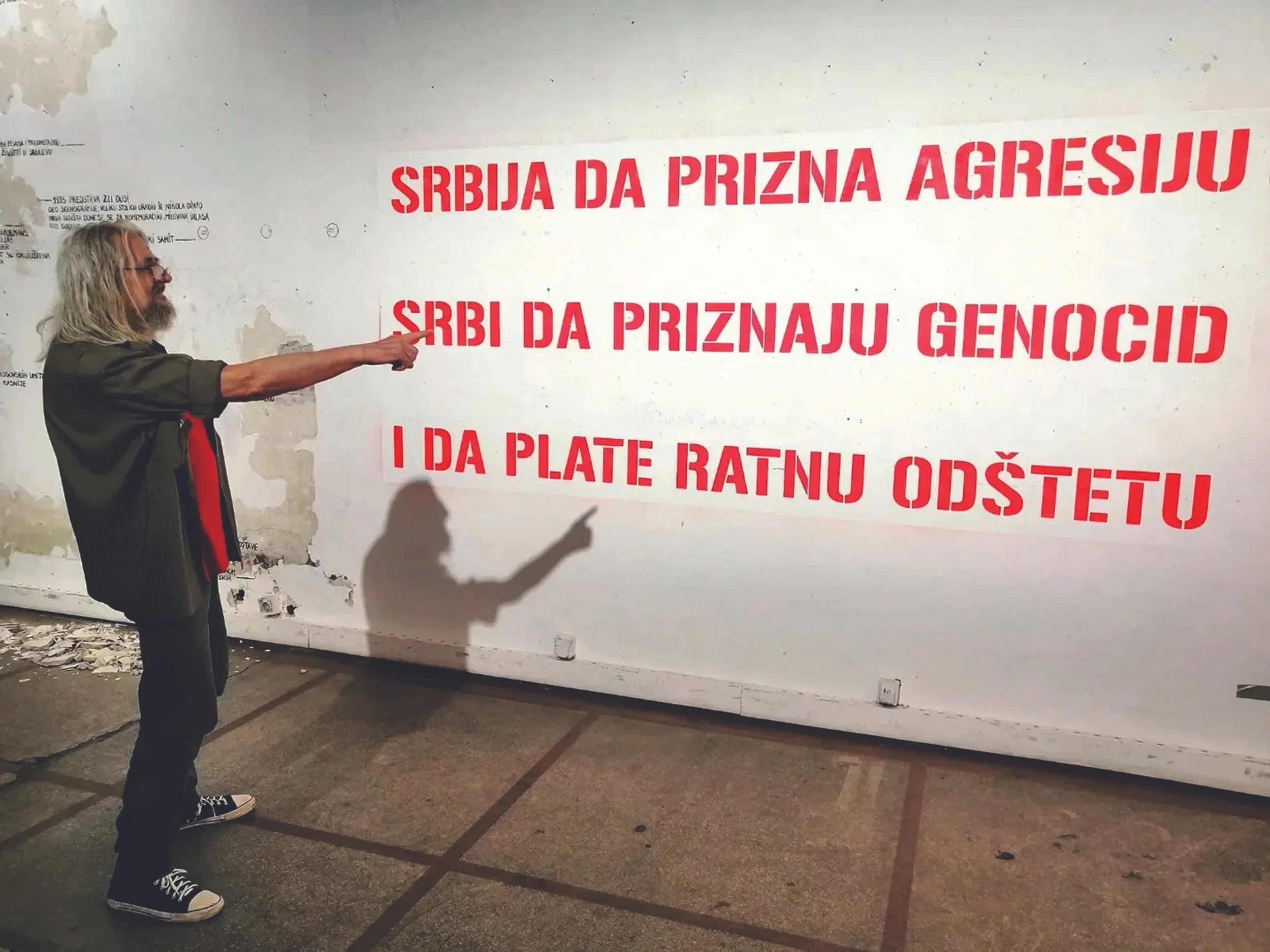
I don't have a nice word for Serbia, nor Serbian people and their elites. Serbians had multiple opportunities to face their genocidal past. To figure out what was bad, wrong, and evil in it, to admit aggression, and to ask for forgiveness. To reflect upon themselves, to acknowledge their wrongdoings, for the sake of humanity, for the sake of truth, and their future’s sake.
Dr. Zoran Djindjić was Krleža’s “one in a hundred years man”, ready to address the truth of the consequences, so this emancipator was executed at his workplace, at the front doors of the government building. That chance is lost. No one is ready to take that risk anymore, and who can blame them? He was the real Serban patriot! Except for his funeral, he never had a huge following. If you ask me about the “situation in Serbia”, I have to say there’s no situation, as the illness and the patient had become one.
As in this bal issue we are dealing with language, its function, repetition, and shaping through political and social formation, it is important to understand that its transformational role seems to come to the forefront in the context of your work. It seems powerful to use language modifications to criticize this society, which (apparently) does not understand or see the role and complicity in the wars of the 1990s. How strong are words and statements in the society we live in?
We are all buried in words. Trivialities raised to the level of events are pouring down upon us. Nothing lasts. The moment the word is out, it’s already covered in layers of interpretations, interpolations, and such.
We are covered with wars! Wars are everywhere, in all spheres, on all fronts, constantly! A war of any kind can not be waged without at least some sort of public approval. Words were on the frontline in the 1990s, just as they are today. It can be said, without much exaggeration, that it all started on the conceptual battlefield! Key operatives of the initial campaigns of the Yugoslav Wars are promoted to even higher echelons, some are still active.
Words seem limited in their outreach when calling for something constructive, but with no sufficient obstacles when calling for destruction, pillage, and murderous resentment. Easier to apply for evil than for good, like so many other wonders of this world. Redeeming words for our common humanity is an important stream of my practice.
The theme of this issue is “Repeated words lose their meaning”. What do you think about this, how much truth is there in this phrase?
Some people think (if that’s not an overstretch), that the Holocaust never happened. There’s no crime in human history so well documented, not a city in Europe without a memorial, it’s so easy to learn about it, but still ...
Last year I went to a former Nazi extermination camp where more than a million humans died horrible deaths, to witness what the industry of death looked like, to see the ovens of Auschwitz and the fields of chimneys of Birkenau. I also saw dozens of groups of school kids guided through the compounds and exhibits by their teachers, being given a chance to see it with their own eyes. The necessity of this eyewitness experience is palpable at that place.
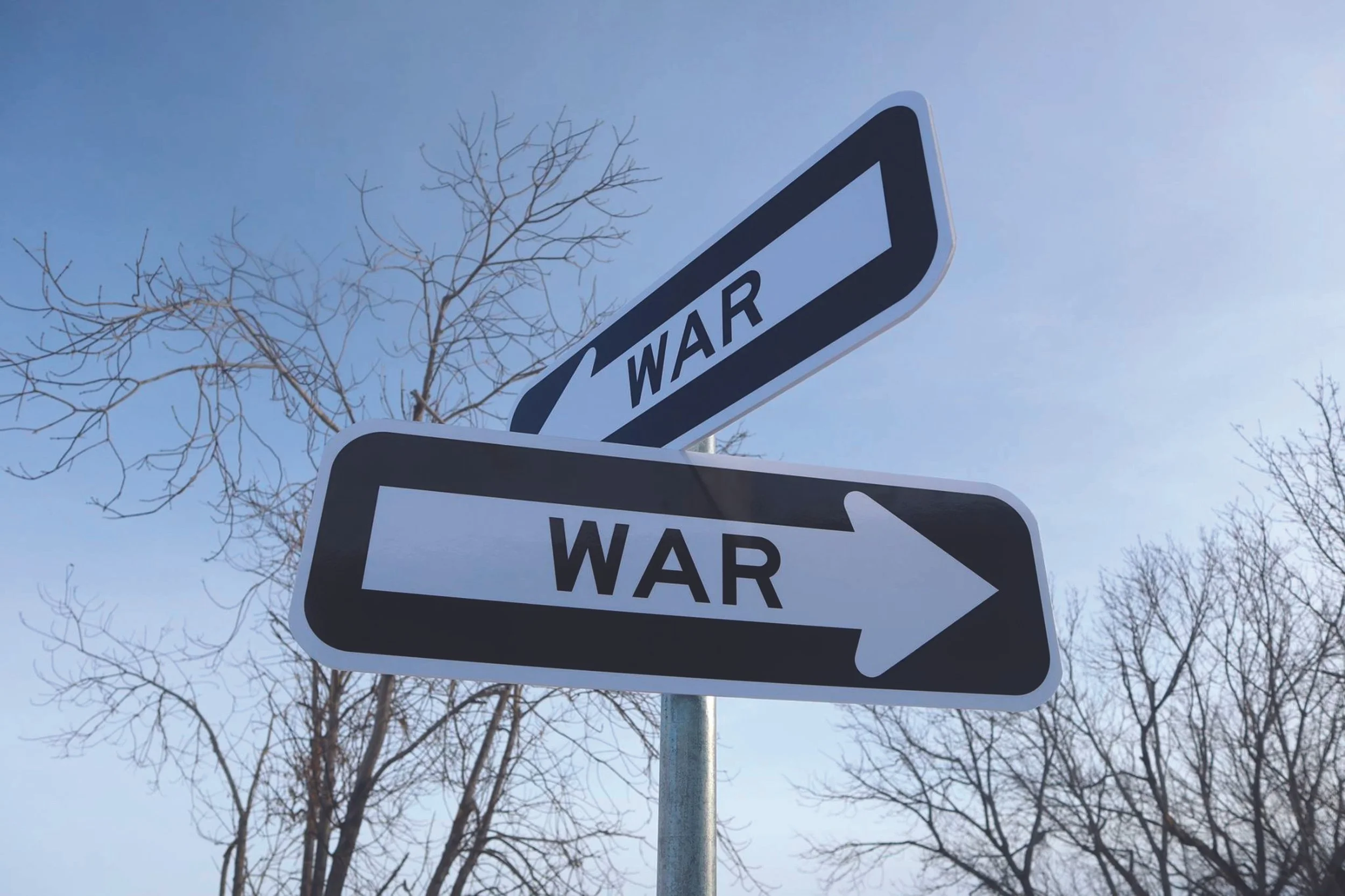
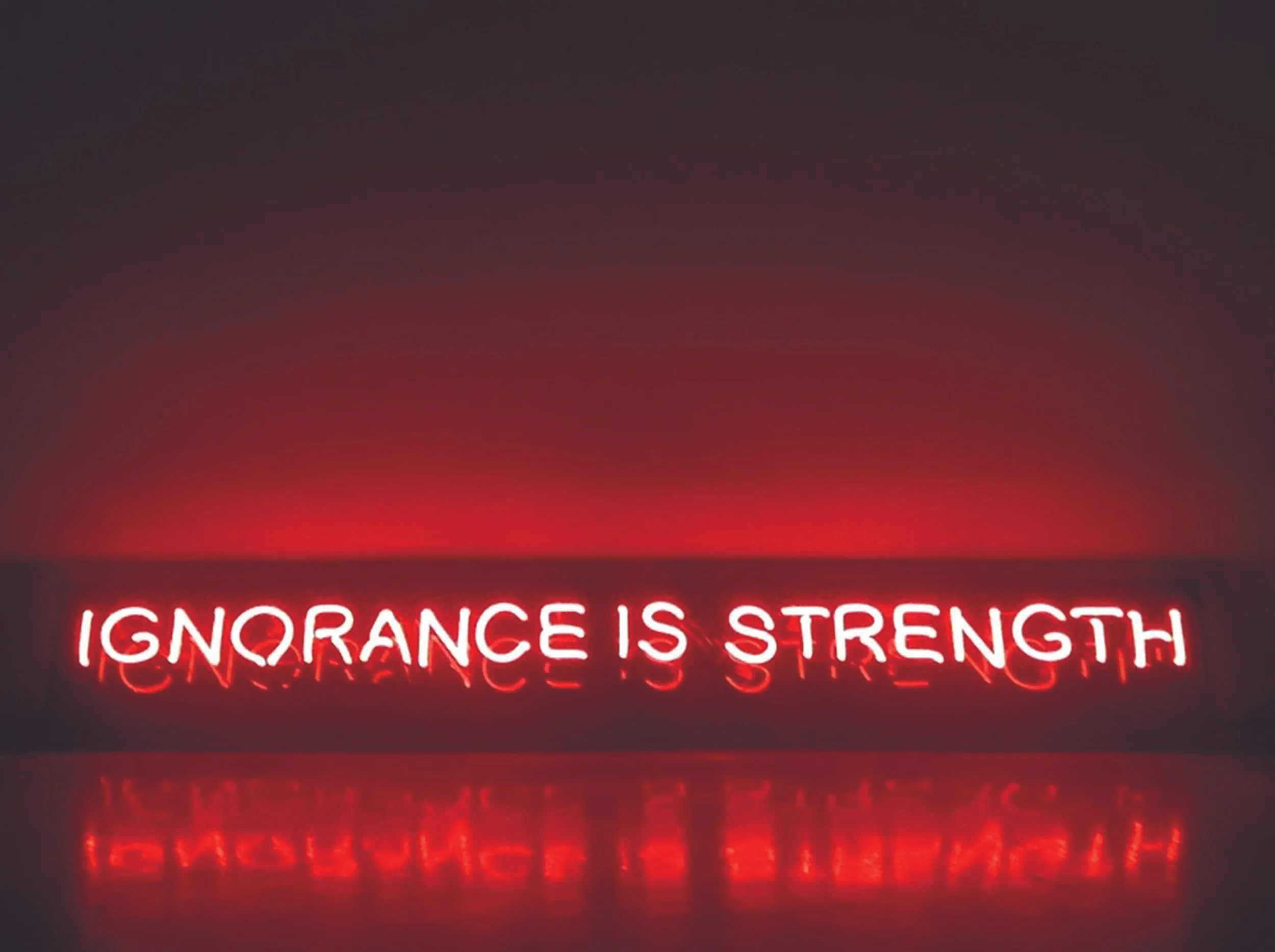
There is plenty of proof, but if you are willing and eager to accept falsehood as truth, then no proof can dissuade you. And when you’re subscribed to that kind of propaganda, your brain is already cooked. So your head’s only use now is to spread that propaganda, like an empty resonating box. “War is peace. Freedom is slavery. Ignorance is strength.” Not a new thing.