In Conversation: About Words, Toilets and Memory
Viktorija Kolbešnikova, Augustas Čičelis, išgirsti queer archive
(Conversation took place in 2024)
V: Augustas, it is a pity you do not like festivals – you miss out on so much gossip! Although queer community in Lithuania is a big gossip in itself. We could map networks of relationships and easily identify the biggest slut. But let us not do that, I am afraid to see myself on the map (or incest soup as we say).
Anyways, I want to talk to you about what happened in queer feminist festival you missed this year. It was huge! And there was the first vandalism act in the toilets. I saw only the aftermath of it (all words written on the wall were covered up) and participated in the closing discussion. It was tense but I think it was necessary and had been imminent for some time. I did not see the sentences myself – best position to start a gossip – but the main idea was that the festival should not allow cis-men and hetero couples to participate. Augustas, hear me out, cis-men! It was written that they should go to gay bars. It became obvious to me that the person or people who wrote these sentences do not know anything neither about the history of the festival nor the country in general. I will always be surprised about the audacity of ignorant people. And usually one can pinpoint the geography of ignorance. There were attempts to make disclaimers about different contexts but I felt that it was there only to make a pretence of understanding the difference.
I am writing this to you because I want to think a bit more about this, outside of the festival. We always underline that our activities and spaces we create are for queer people by queer people. When we say that, I feel that we know what we mean. But how would you describe it?
A: I am not sure if not liking festivals is the right expression… Well, I actually do not like some aspects of outside fests or camps, but some aspects I really crave for. Also I might miss the festivals but not the gossip, even if I do not actively seek it. The whole situation you’re describing again reminds me of this East-West dichotomy where only one can be progressive and the other one must be the essence of backwardness (to show how progressive is the first one). Suddenly, I see those Germans, Austrians and French continuously suggesting Ukraine to make dialogue with the aggressor, solving russia’s war against Ukraine – massive military invasion, assault – with slogans of love and peace, beautiful No War and Stop Militarisation signs. They know best. For so many years we have been told that only by following the footsteps of the West we will become happy. This also defines the context of our išgirsti queer archive.
I am glad that we finally see possibilities of our own paths, our own uniqueness. We finally acknowledge our own history, even if so much of it is destroyed or lost, which at times makes it extremely difficult to refer or anchor to the past, define our own culture. The gossip plays an important role here too. If we cannot know the truth, we can create it, making our own sense of the world. I do not know the true intentions of the ones who painted the words on the toilets, I even was not there, but I also do not say that their true intentions were stupid or genius. I can only talk about my own associations, my own feelings. If one invades a space by writing something they must be ready to face that this might be accepted as disrespectful, damaging, demeaning, or as you say – simply as an act of vandalism. One might think that they bring their great wisdom and invaluable experience but the community might be too resistant, too strong, too confident to be indoctrinated. On the other hand, one might say, they are so backward that they ate the priest. Well, let them. I feel that finally we have built enough experience and confidence to not feel backward all the time. Colonialism is not only about actual colonies.
By saying all this in no way I am questioning the need for women-only spaces. I also believe that not all cis-men coming to the festival you are referring to are sensitive enough not to take up too much space, acknowledge that this is a women-led event, and reflect on their privileges in this world. I remember one year when a bunch of straight guys took over the playing ground. That was annoying indeed. But is the gay bar my place? Somehow it never was. So far for more than a decade somehow I find myself organising things which mainly women and the trans community are interested in. Is there still a lack of focus on women and the trans community? Certainly yes. For instance, as you know we are constantly thinking about how to build up material on women and trans people in our queer archive.
We are saying that firstly queer is LGBTQ+. That is, for us it is important to acknowledge the existence and importance of identities in many people’s lives. But it also has this aspect of focusing on less represented, going against or on the side of the mainstream. It is like a fluid substance finding the deepest gaps. Of course I am not that naive to think that we are finding and filling in all the gaps. That is why there will always be the ones who feel not represented by us, neglected by us. Sometimes it is a conscious decision, sometimes it is a lack of resources and sometimes it is our inability to see, to know everything which is important. But even in the latter case I would not want some words on the išgirsti toilet, would you?
V: Oh, such a dense response, so many topics, so I will try to answer them one by one.
Firstly, I believe that we lack some language or nuance in describing this East-West division: we see and feel it but I think it is a bit dangerous to operate in this binary logic because it can easily reproduce the division with a hierarchy implied in it. Similarly with an ongoing war. Can we find a better time to talk about peace and anti-militarisation? Certainly, dialogue is not a sustainable option, dialogue is possible between equals. Such crises are also a fertile ground for different interests that have nothing to do with peace, often the other way around. They can also be women or gay led. The past, the same as the present, is very complicated, and we often find ourselves in a situation where two contradicting things can be true at the same time.
Gender dynamics are also changing in times of war. In Ukraine, people with male gender markers in their passports now are in the most vulnerable situation, especially if they are poor, HIV positive or identify themselves as not cis-men. Therefore I think, as you mentioned, we have to keep our minds open for our own paths and uniqueness even in times of despair and brutality. International solidarity can foster those complicated talks about tangible peace and sometimes even through conflicts, we can slowly move toward less divisive strategies existing in this world.
Thus, I see the toilet vandalism accident in this way: a toilet, as a semi private space during a public event carries different meanings. Someone had to be very pissed off to spend time locked in a cabin with a queue outside to make a statement. A statement with an imported knowledge that did not correspond with locally produced practice. It was brought up, discussed and rejected. A toilet vandalism also is a place for those whose voices are not heard, sometimes toilets become a space for practices that are seen as deviant, sick or criminal (you know I am talking about cruising). Such acts are not held by people in power, so the clash we experienced became an object of political discussion that was also possible because of the anonymity of the messages. The result of the discussion was that practices and how we interact with the world is more important than identities. I know it’s utopian and underrepresented groups definitely need more recognition but at the end of the day, how do we describe a world that we would be willing to live in?
The mentioned gay bars – the walls of the toilets become a board of different knowledge or lack of it. But I mean, what bars are we talking about? The only one that exists in Lithuania? So coming back to your question, if something that would be written on the walls of our space would actually ignite certain change, would bring up an important question or would give valuable criticism to our work, I would appreciate that, keeping in mind that it might have been too complicated to directly state the opinion. The other question is, what would we do? Paint it over, keep it? What would a queer archivist do in such a case where the imprints of our existence is usually dissent?
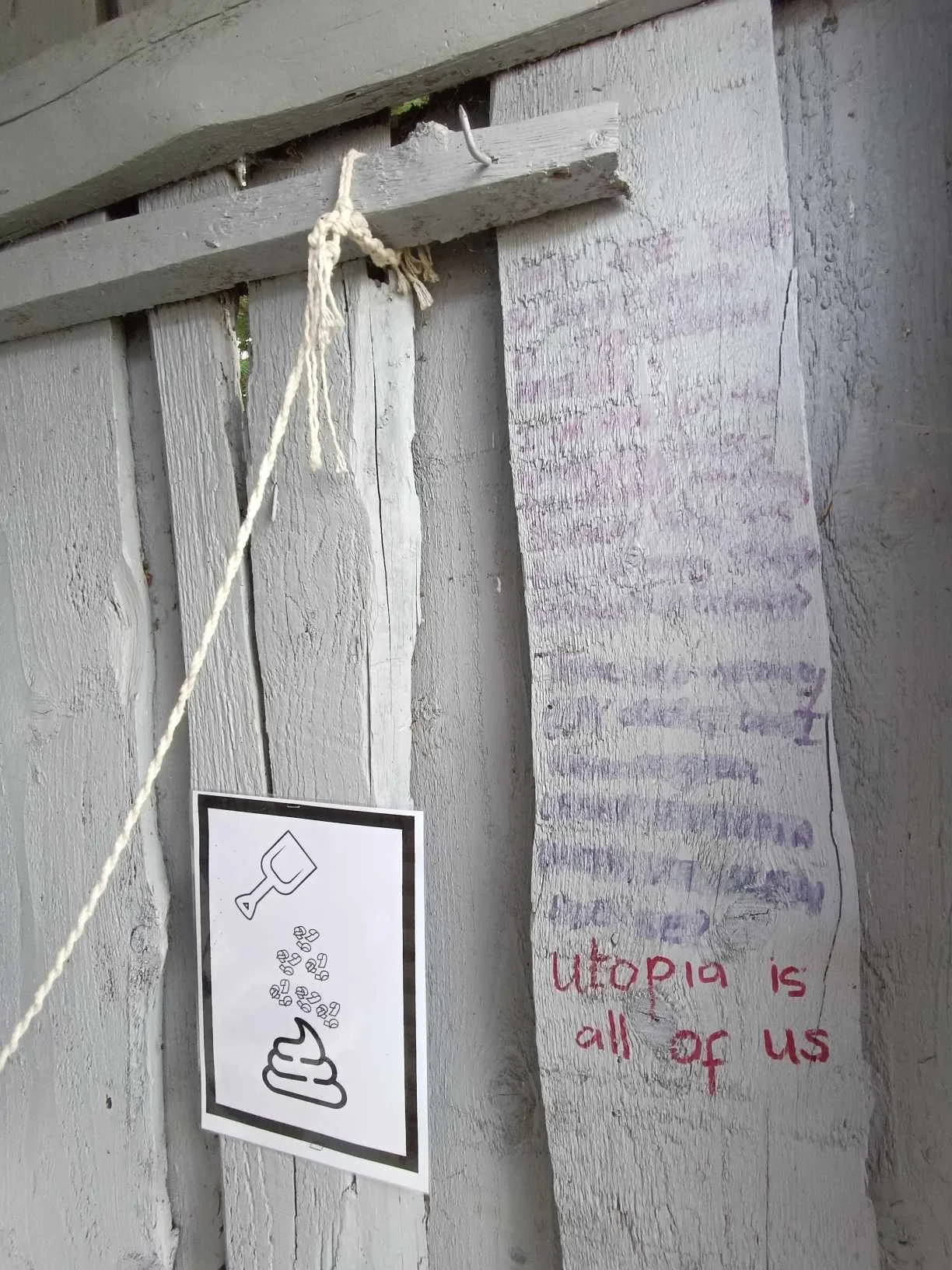
A: I already had a vision of how we are cutting the toilets in pieces and saving them for the future generations. Well, I wish some pieces of public toilets from the soviet era had survived. Where could they have been stored? That is a different question. An important one, though. I do not believe a queer archivist can save everything. We are already saving these writings in a way here. Do we need the actual words? Maybe there is some value in dissent sometimes. So much art is created as a reference to something which is no longer here or almost gone. Sometimes an interpretation, a gossip or relation to an object is much more important that the object itself. Unfortunately, you showed me some photos of the writings in the toilets at the festival or rather what was left of them after my initial reaction. Judging by some responses, I had imagined them much much larger and on the exterior. I had already created a myth in my head, which led to all these other topics which are important to me and our archive. The actual writings are not that much of an interest for me any longer. Of course I am very limited to my own interests, understandings and approaches – that is why we need others.
What we can certainly do is to encourage queer people to care about their own history, to care about what is or was important for them. People tend to think that now is forever. It is not. You remember, when we archived queer Covid experiences a couple of years after the pandemic, people had already forgotten so many things. And that was quite an unusual time. Firstly we can become archivists of our own lives which inevitably extend to wider collective experiences. If one thinks that some writings are important and worth saving, there is a chance they will be important to some others. Often we cannot foresee the true historic value. Surely I would not want to put all the focus on the individual. Organisations and state institutions have to take their own responsibility. However, as we have found out, a lot of important things are saved by individuals, as well as destroyed, especially in the times of state censorship, neglect and homophobia (which is so easily internalised).
V: For sure, thinking about the process in general, is part of the archiving. I remember us discussing, who will be the queer hero in Lithuania? Whose sculptures will be put in the streets? Through which lens the canon will be written? And I am pretty sure that it will not be people who write on the walls, who were caught by police having public sex or who had to sell drugs to save money for gender-affirmation therapy or performing illegal abortions for refugees. Though, I want to be wrong, I want a history of wrongs not heroes.