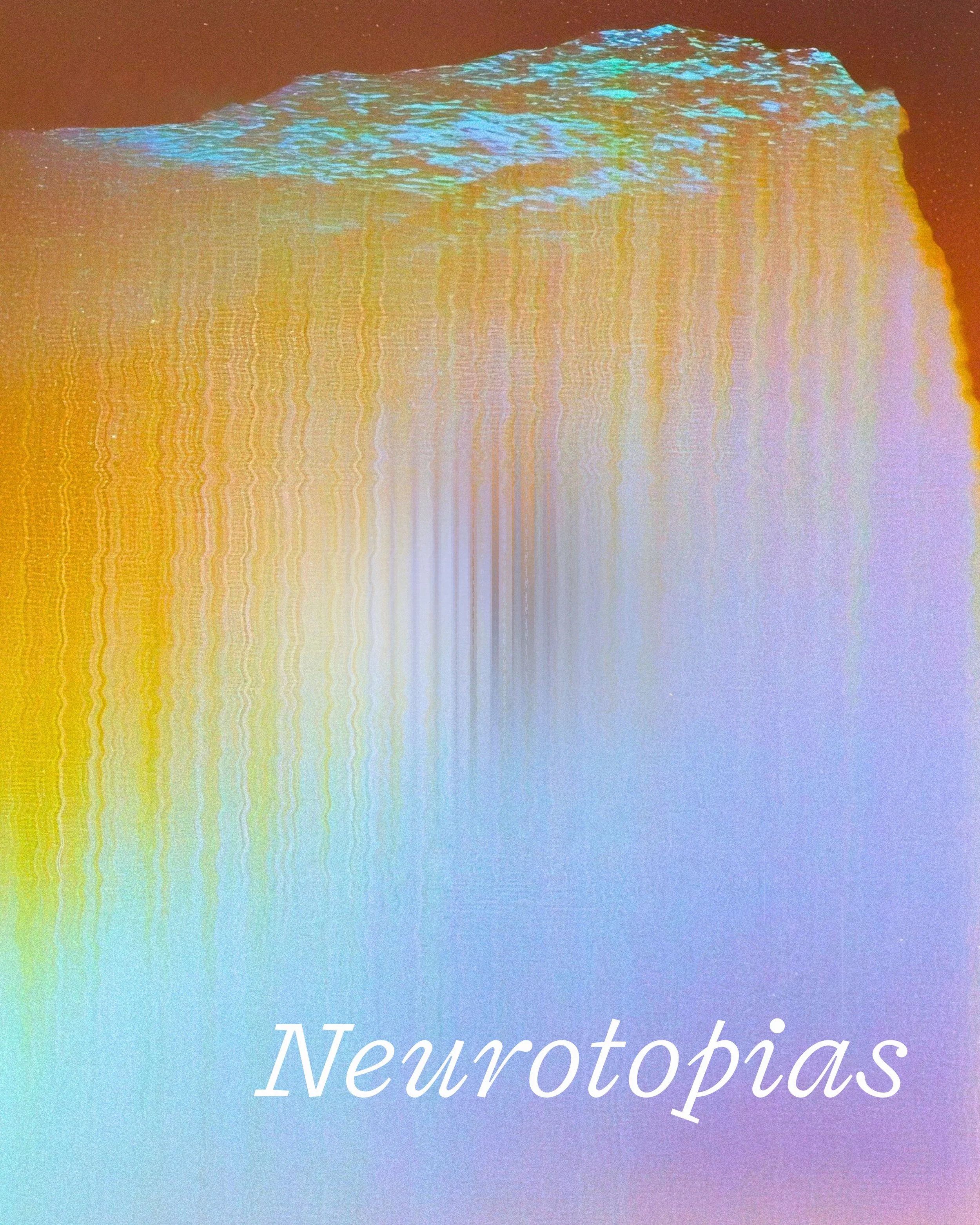
Vote for Neurotopias
Support Neurotopias With Your Vote until April 7!
Our upcoming programmatic contribution to this year’s Mental Health Awareness Month is in the competition for a microgrant from the European Network of Cultural Centres (ENCC). With your help, we can improve the project and bring to life some of the theoretical discourse on neurodiversity and accessibility. You can learn more about the project, why we need the funding and what exactly will we do with the grant below:
Group Exhibition & Public Program
May 20–July 22, 2026
Curated by Barbora Horská
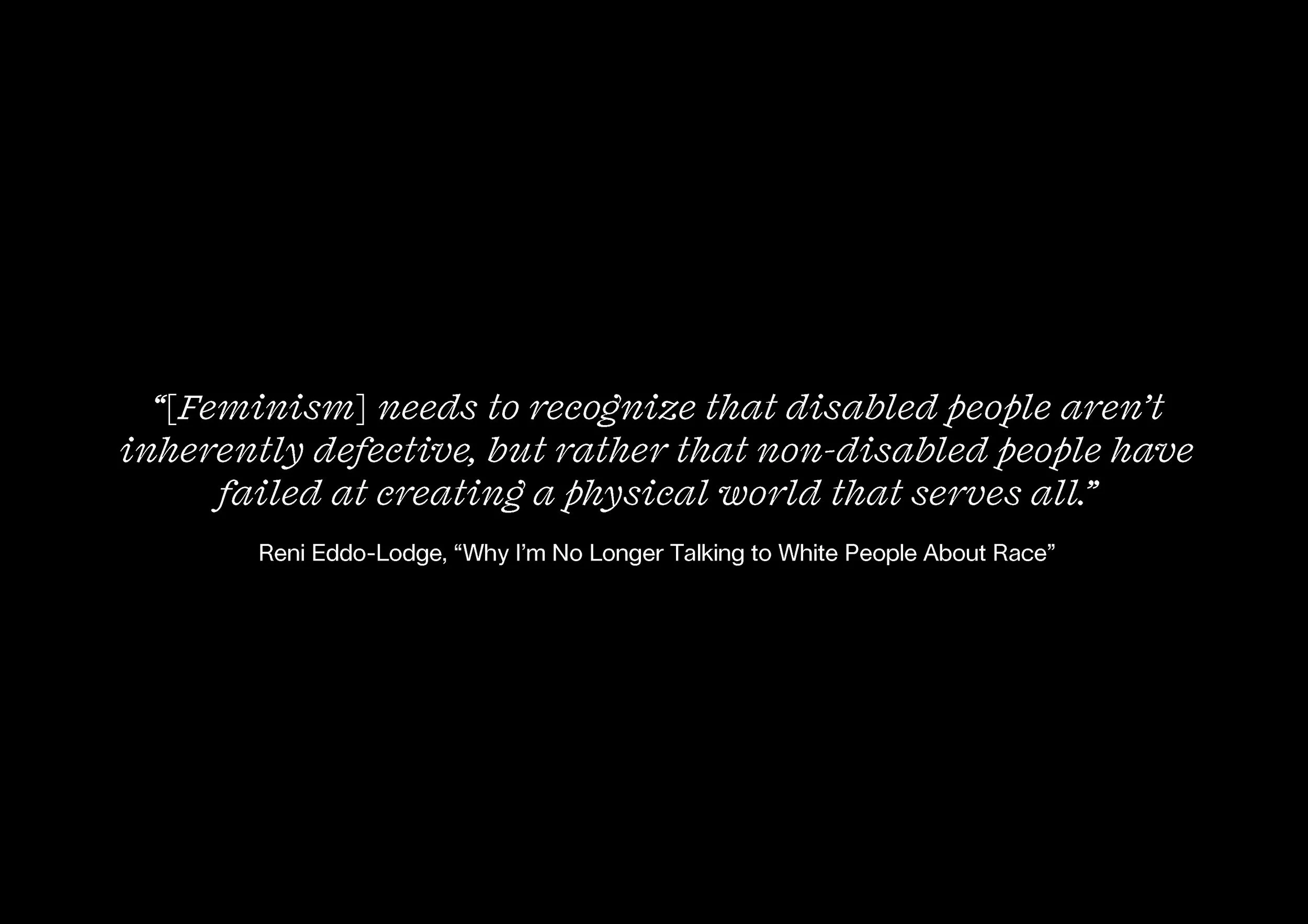
Departing from Eddo-Lodge’s critique of feminism that fails to consider the physically disabled in its demands for societal changes and inspired by Robert Chapman’s analysis of ‘normality’ through the lens of neurodiversity and capitalism, Neurotopias project pushes the boundaries of mental health awareness centered on destigmatization and therapy accessibility into politicized framework and sees artists as the architects of possible new futures—futures that prioritize well-being of all over economic gain of the few.
How would a truly accessible society look like? Materially, socially, infrastructurally? What kind of economic system could accommodate people with different abilities and take into account more-than-human needs? How can we offer each other care without pathologizing the issues or denying their existence? What would our surroundings—our homes and cities—look like if we create them from feminist, disabled, and neurodiverse perspectives?
Centering the voices of those deemed by society as disabled, Mad, and neurodivergent, Improper Walls invited artists to envision what an equitable and neurodiversity-affirming society could look like. For the seventh edition of the mental health awareness exhibition, artists were encouraged via an open call to let their creativity expand beyond the ‘possible’ and ‘realistic’ solutions limited by the current economic systems, and propose alternate realities that take into account the full spectrum of dis/abilities and needs. Informed by feminist thought, disability justice, and the Mad Liberation movement, this exhibition and related public program are looking to create a space for a critical analysis of psychiatry and deconstruction of ‘normality,’ without slipping into the dogmas of the anti-psychiatry movement of the 1960s and ‘70s.
The open call format for artwork proposals has been chosen to ensure that the exhibition deals with topics that respond to the community’s needs rather than being artificially derived from a theoretical discourse.
To complement the conceptual character of the exhibition, the public program will address some of the practical issues that may stand between us and these pseudoutopic futures, including their envisioning. The featured workshops will focus on the development of practical skills and the empowerment necessary for perspective changes. From de-growth and DIY to digital world-building exercises, the program’s aim is to turn the audience from a passive spectator into an active creator with the potential to bring the exhibited ideas closer to life.
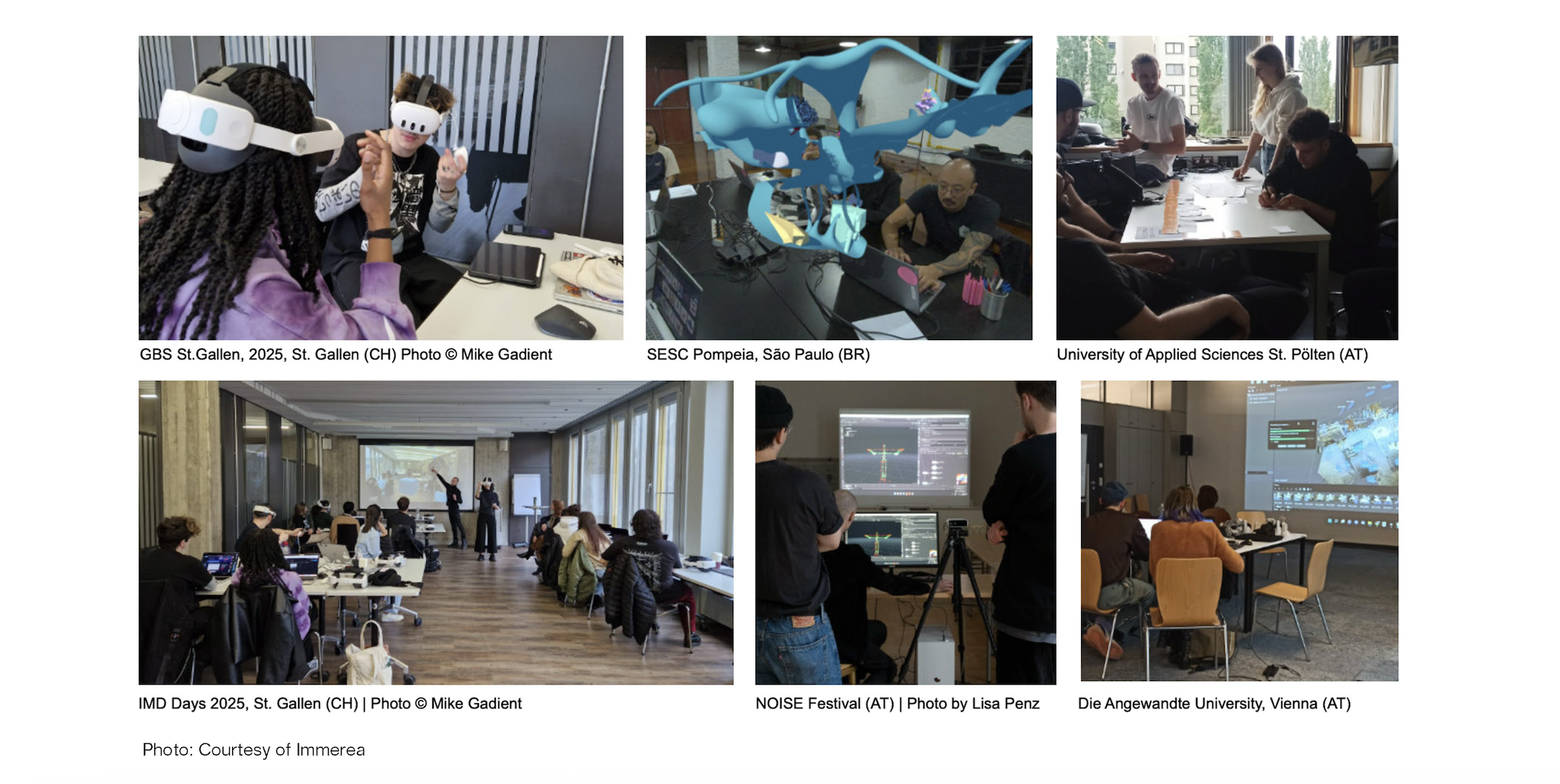
One part of the public program is planned to engage a group of high school students from a local school in an in-depth, 3-part workshop organized in collaboration with a local artist duo whose practice is focused on virtual reality games and immersive installations. The program will offer students an opportunity to critically reflect on who is empowered by technology and digital media and who remains excluded. Particular attention will be given to usability barriers, dependency, and the skills, knowledge, or resources required to navigate digital spaces safely and meaningfully.
Why do we need the funding?
Improper Walls is a non-profit cultural platform fully dependent on public funding. While the City of Vienna, the Austrian Ministry of Housing, Arts, Culture, Media and Sport, and Vienna’s 15th district, where our space resides, support in part our yearly program, the received funding is not sufficient to cover all the material costs and fair pay of the artists, curators, project coordinators, and others involved in the exhibition and program production. With this grant, we would be able to provide the selected artists with better remuneration for their work, cover potential transportation and insurance costs, and support the production of more complex pieces via material costs and exhibition design coverage. This aids the project in reaching a higher quality overall, which in turn has the potential of better public recognition and community impact by engaging the audience in more depth via workshops and talks to explore multiple perspectives brought up by the selected artworks. It also directly supports the selected artists in their practice. This funding would also be used to fully cover the costs of organizing the in-depth digital inclusion workshop for a group of 10-15 local students.
How will we use the grant?
Improper Walls has been participating in Mental Health Awareness Month with an annual exhibition and accompanying public program since 2020. For this year’s edition, we have teamed up with Vienna-based studio Immerea to offer an in-depth 3-part workshop focused on digital inclusion in emerging technologies to a group of students from a local school between the ages of 15 and 18 years old. The workshop, in alignment with the overall topic of Neurotopias, will focus on digital inclusion, technological accessibility, and the social impact of emerging technologies such as AI and next-generation spatial computing technologies. It addresses questions of equality and discrimination, examining how social and gender-based inequalities are reflected in devices, platforms, and digital content, and how these dynamics shape experiences of participation, accessibility, and care. Participants critically reflect on who is empowered by technology and digital media and who remains excluded. Particular attention is given to usability barriers, dependency, and the skills, knowledge, or resources required to navigate digital spaces safely and meaningfully. By combining critical discussion with practical concept prototyping, participants engage in hands-on activities, collaboratively developing scenarios, fictional products, or practical solutions through pen-and-paper methods. Through role-play presentations, the results are then discussed and refined, followed by critical reflection on their social, ethical, and practical implications, positioning the workshop as a site for imagining a more inclusive future.
Thank you for helping us continue the trajectory of cultural production as a tool of active civic engagement instead of a purely aesthetic experience, and offer diverse opportunities for discussion, learning, and skill-sharing.
Past Editions