
Opening: October 7, 6 PM (part of bal’26)
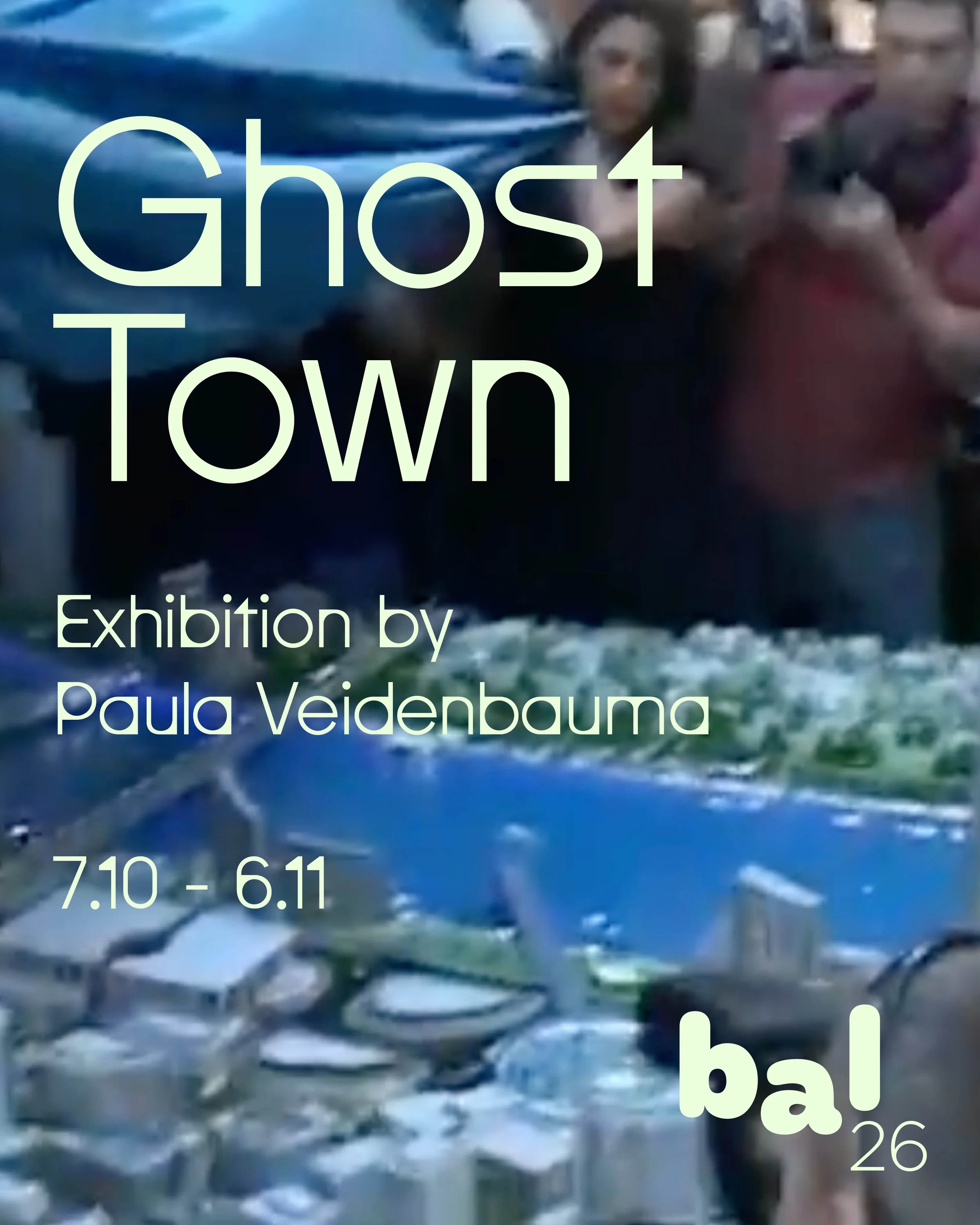
Ghost Town proceeds from the emergence of two waterfront developments on Europe’s east: Belgrade Waterfront and the recently announced Riga Waterfront, both developed by the Abu Dhabi-based Eagle Hills. Having transformed parts of Belgrade, the developer now promises a Riga riverside makeover through a multibillion-euro investment, branded as the city’s future SoHo or Dubai of the North.
Centred on the video work River Rapids, where a potential buyer encounters a Riga Waterfront sales agent in their showroom and teleports to its Belgrade counterpart via portals in the model flat, the exhibition revolves around sculptural assemblies of contemporary oligarchy landscapes, where architecture, caught between promised luxury and the thin air of golden visa promises of landing, is tied together with greed in intraterritorial teleportation urbanisms. The exhibition explores the most desirable vantage point from which to see a spectacular sunset setting over a city with high investment potential.
Exhibition reader will include contributions by Ieva Raudsepa and Wies de Wit.
About artist
Paula Veidenbauma (b. 1997, Riga) is a Vienna-based artist and curator with a background in Urban Studies and Film and Theatre Theory. Her practice, in its different articulations – fantasising, organising, plotting, making, writing, directing (...) – engages with project(ed) dramaturgies, mobility politics, conspiracies and rumour. She often works with spatial enigmas in urban political ecologies, using investigative approaches across interconnected geographical contexts. Her work has been presented at the Venice Architecture Biennale (Estonia Pavilion, 2023), Copenhagen Architecture Biennale (2021), Living Room, Athens (2024), and the Lithuania National Art Gallery in Vilnius (2026), among others. She teaches at the Estonian Academy of Arts, and co-curates gel office and portanuova performance series. paulaveidenbauma.net
bal’26: Dismantling the Promise
bal’26 thematic focus looks into resistance against power structures. With the title Dismantling the Promise, the program reflects on the consequences of power agreements and connections, as well as the missed opportunities for solidarity, care, and dissent when viewed from a feminist standpoint. It is an intentional look back at the power structures that constrain the autonomy of marginalised bodies and their landscapes of physical territories, social spaces, and embodied environments—turning back toward these structures, using their own tools of language, technology, and speculation against them.
bal’26 program is perceived as an exhibition which is multilayered and denies the common structure by bringing together artworks (including research presentations) in different formats that unfold over time. Exhibition Ghost Town by Paula Veidenbauma forms a constant presence, while additional works: short film (The City That Has Peace by Petra Matić), a performance (RADIO GLAS DRINE by Vildana Hermann), a performative reading by Collective Dreaming , publication presentation (Body as an Archive: Performative Art Practices in Postwar Kosova by Anyla Kabashi and Renea Begolli), bal screenings and a symposium are introduced at different moments. These function independently, yet remain in dialogue with the Ghost Town creating a shifting field of relations across the duration of the exhibition.
The selected presentations in the symposium cover problematic decisions regarding transregional via-politics of so called Baltic Sea – Black Sea – Aegean Sea Corridor stretching from the Baltics to the Balkans (Corridor Limbo by Paula Veidenbauma); investigate how weaponised digital tools are recognised and reclaimed by feminist artists (Feminist Data as Resistance: Algorithmic Bias, Bodily Autonomy, and Digital Feminist Resistance in the Post-Yugoslav Balkans by Ana Marinković), expose how city scapes and eco systems co-exist and are disrupted by political governance (Ecologisation of Architecture by Aljaž Rudolf), and explain how Aesopian language influenced the transgenerational somatic effects of repression (Aesopian language by Rūta Junevičiūtė).
A separate event of bal screenings, will invite to view three anthropological short films. Through a slow, observant lens, the film program invites into liminal spaces imbued with a sense of freedom, waiting and the passage of time. Included films are Pagirnis (dir. Anastasija Pirozenko), I Have A Song To Sing You (dir. Eluned Zoë Aiano, Alesandra Tatić, Greta Rauleac), Mother Mare (dir. Elisa Chiari).
During the opening of the exhibition, the bal’26 publication will be presented with contribution by Helena Aadli, Renea Begolli, Likana Cana, Hana Čeferin, Anton Goncharov, Vildana Hermann, Rūta Junevičiūtė, Anyla Kabashi, Kroplya, Diona Kusari, Ana Marinković, Petra Matić, Milica Popović, Justina Špeirokaitė, Saša Tatić, and Paula Veidenbauma.
Curated by Justina Špeirokaitė
Curatorial and editorial team: Merete Väin, Ajda Ana Kocutar, Lara Mejač, Urtė Špeirokaitė, Miloš Vučićević
Graphic design by René Vogelmann
Supported by BMWKMS, MA7, 15. Bezirk, Lithuanian Council for Culture, the Lithuanian Embassy in Vienna, the Estonian Embassy in Vienna, and Ministry of Culture of Kosova
bal is a transdisciplinary comparative project exploring the artistic and cultural landscapes of the Baltic states and the post-Yugoslav region. Combining academic research, artistic practice, public discussion, and critical discourse, the project challenges homogenising views of Eastern Europe and foregrounds diverse identities and experiences. Through an intersectional perspective, bal examines how historical and contemporary transformations shape the lives of women and others affected by intersecting forms of marginalisation.