
Double-click to edit...
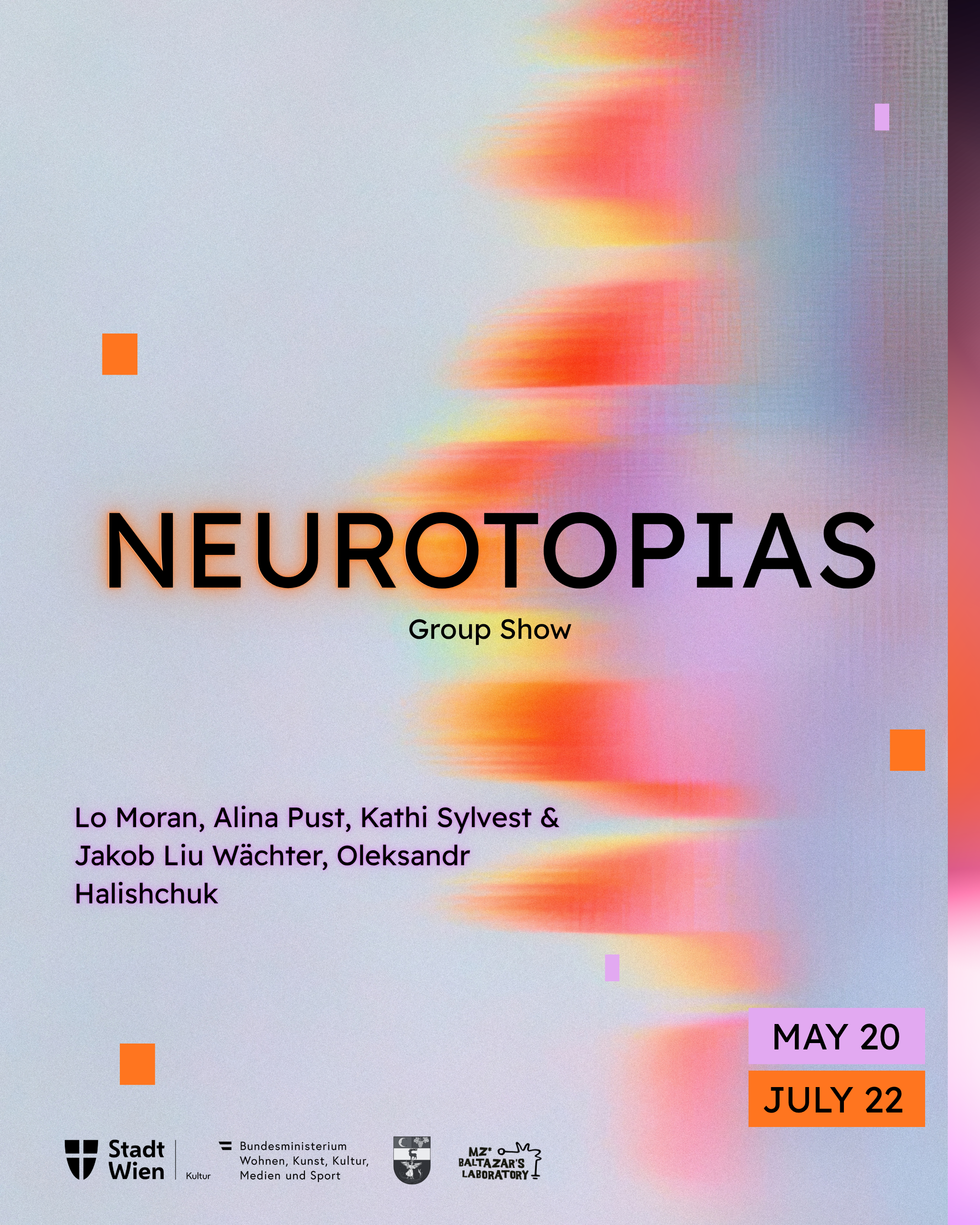
Design: Ale Zapata
Opening: 20.05.2026, 7-10 PM
Exhibition Duration: 21.05.2026 - 22.07.2026
Participating Artists: Oleksandr Halishchuk, Lo Moran, and Alina Pust
Curated by: Barbora Horská
Assistant Curator: Ola Plankenauer
Visual Design by Ale Zapata
Accessibility Design: Sabrina Haas
Neurotopias is the seventh edition of Improper Walls’ initiative to participate in the Mental Health Awareness Month with an annual exhibition and accompanying public program that uses artistic means to encourage open discussion about often stigmatized topics, their deeper context and socio-political repercussions. This year, we invited artists via an open call to reflect on what a truly accessible society would look like, materially, socially, infrastructurally, asking: What kind of economic system could accommodate people with different abilities and take into account more-than-human needs? How can we offer each other care without pathologizing the issues or denying their existence? What would our surroundings—our homes and cities—look like if we create them from feminist, disabled, and neurodiverse perspectives?
While the artworks in the resulting exhibition offer the audience different access points into rethinking the status quo, the exhibition itself is a testament to its current limitations. Using an open call format as a way to ensure diversity fails at the inability to offer participants fair pay and artwork production support due to scene-wide budget cuts. Such a situation in an already precarious cultural field defines who is and who is not able to take part, and with that, whose experience and point of view gets to be represented. Beneath, is also the layer of the topic itself, because even though the intention is to deconstruct the concept of ‘normalcy’ and challenge the pathologization, the neurodiversity discourse is still dominated by White voices and experiences with both language and concept too tied to Western psychiatry and historically, in Austria in particular, to eugenics—once a popular ‘science’ across the political spectrum.
Neurotopias are, therefore, an invitation to unmask, express, envision, and connect, but also to notice who gets the privilege of doing so and why. And maybe that, could be the starting point from which we can build a better system for us all.
Featured Artworks
Best Possible Future by Alina Pust
Best Possible Future is an interactive, interview-based work that explores how people imagine a “best possible future” while being grounded in the imperfect realities of the present. The conversations are recorded in everyday environments—spaces with ambient noise, interruptions, and textures of lived experience—embracing their non-ideal conditions as part of the work. Each interview begins with questions of gratitude, values, and perceived challenges, before the artist guides participants into speculative imagination. From multiple distances—intimate and systemic, concrete and abstract—they envision a world 200–300 years ahead in which social, ecological, and relational systems have unfolded in the best possible way. The project traces how these visions emerge, what limits or expands them, and what answers people already carry within themselves. The resulting material—edited audio tracks—forms a constellation of future imaginaries, revealing shared patterns of care, coexistence, and transformation.
Khutir by Oleksandr Halishchuk
Khutir is an interactive multimedia installation, visually inspired by the book “Evenings on a Farm near Dikanka,” a book about a quiet place, full of love, drama, devils, and witches. Carton houses coated in gypsum and covered with the artist’s political and anarchistic notes stand on a simple kitchen table to refer to the space most likely to be used to express dissidence and anger in former USSR households. The artwork is completed with zines and microinstallations of places, actions, and everyday scenes made out of found objects and trinkets. The author rejects utopia as a concept appropriated by reactionary and authoritarian ideologies like fascism, neoliberalism, or the so-called communist regime, and instead plays with building new perspectives via sincere communication that serves as a starting point for societal change. Inspired by David Graeber’s “The Dawn of Everything,” the work questions socio-political structures, tribalism and the idea of only one functional system through unifying forms of communication: imagination, toys, games, and text. Khutir invites to touch, feel, and enter, to help us realize we are not alone in our anger.
Normativity Detox by Lo Moran
The Normativity Detox inverts the aesthetics of conversion therapy alongside cult, religious, and wellness tropes to dismantle the systems that pathologize and delegitimize queerness and neurodivergence. This iteration is a video appropriating the affective language of contemporary influencer practices and conversion therapy rhetoric to guide viewers through participatory "therapies" to "cure" neurotypical compulsions toward interdependence, care, and worlds where unmasking is not only safe but comfortable. The work insists that "acting normal" is a survival strategy, not a choice, and that unmasking is an everyday political framework to create more access for everyone.
Public Program
20.05.2026 | 7–10 PM | Vernissage
02.06.2026 | 6–7:30 PM | Queer Bodywork Session
Workshop with Magdalena Chowaniec in collaboration with Raw Matters
POSTPONED UNTIL AUTUMN 2026
27.06.2026 | 2–5 PM | Digital Inclusion in Immersive Technologies
Workshop with Immerea
RESCHEDULED: OCTOBER 3, 2026
11.07.2026 | 11 AM–4 PM | Tactile Intelligence: Rethinking Consent through Embodied AI Prototyping
Workshop by Patrícia J. Reis in collaboration with Mz*Baltazar’s Laboratory
22.07.2026 | 7–10 PM | Finissage
About the artists:
Oleksandr Halishchuk is a multimedia artist, queer-anarchist and curator from Melitopol (southern Ukraine). In their artistic practice, private-sincere and political-triggering are inseparable. They like to explore the intersections of concepts such as truth and sincerity, hearing and listening, presence and being somewhere physically through personal (marginalized, queer, traumatic) life experiences.
Lo Moran creates interdisciplinary projects that are socially engaged, participatory and collaborative, experimenting with and questioning the systems we are embedded in through connection, openness and nonhierarchical learning. Working toward accessibility and reimagined ways of being together, their practice spans social practice, performance, printmaking, illustration, educational work, and archival methodologies. Lo has performed experimental sound internationally for 10 years and been involved in disability art communities for 13. They embrace fluidity and chaos to contribute to emergent futures and radical approaches.
Alina Pust is a Ukrainian interdisciplinary artist and educator working across drawing, performance, music, and interactive practices. She explores imagination, care, and storytelling as collective processes. Since 2017, she has participated in performative and community-based projects, including Speaking Portraits at the Gogol Festival (Dnipro, 2020). She co-created performative works, Narrative Presences and No Distance Allowed, that are based on the personal stories of people displaced by the war in Ukraine. Currently based in Vienna, her practice focuses on listening, relationality, and collective future-making in times of crisis.
Immerea is an indie studio based in Vienna, focusing on the development of virtual reality games and interactive installations. Coming from a background in media art, architecture, and design, their vision is to create projects of high artistic quality and experimental character, pushing the boundaries of immersive and interactive technologies.
Patrícia J. Reis is a media artist, researcher, and lecturer based in Vienna. Her practice engages critical and sensorial approaches to technology, employing hacking and ecofeminism to question systems of control and address the complexity of contemporary technological and social systems. She lectures at the University of Applied Arts Vienna, where she leads the Elise Richter PEEK research project Hacking the Body as the Black Box.
Sabrina Haas is a designer and researcher based in Vienna. Her experience involves working across multiple media and formats, from short films, exhibitions, and artistic research, to creative workshops and journalistic formats. She wrote her master’s thesis on neuro-inclusive design practices and is now looking into how they can be applied in art and cultural spaces, and the wider insights this may surface.
About curators:
Barbora Horská is an editor and cultural worker based in Vienna. She studied transmedia art with a focus on participation and currently works as an editor, writer and curator at Improper Walls. Her practice is about using artistic means to draw attention to socially engaged and environmental issues, with a particular focus on education and mental health.
Ola Plankenauer is an anti-disciplinary artist and researcher based in Vienna. With a background in art history, dance and art, their practice moves fluidly between visual art, performance and material research. Their work engages with bodies and binaries, drawing from the mystique, the monstrous and more-than-human to explore themes of transformation, non normative embodiment, and resistance.
The exhibition and public program are supported by MA7, BMWKMS, 15. District, Raw Matters and Mz*Baltazar’s Laboratory